Small cap mutual funds: are you taking the right kind of risk with your money?
Indian small cap fund AUM hit ₹3.29 lakh crore in 2024 — up 33% in one year. But are investors taking the right kind of risk? Learn how to analyse small cap mutual funds using rolling returns, Sortino ratio & active weights before you commit serious money.
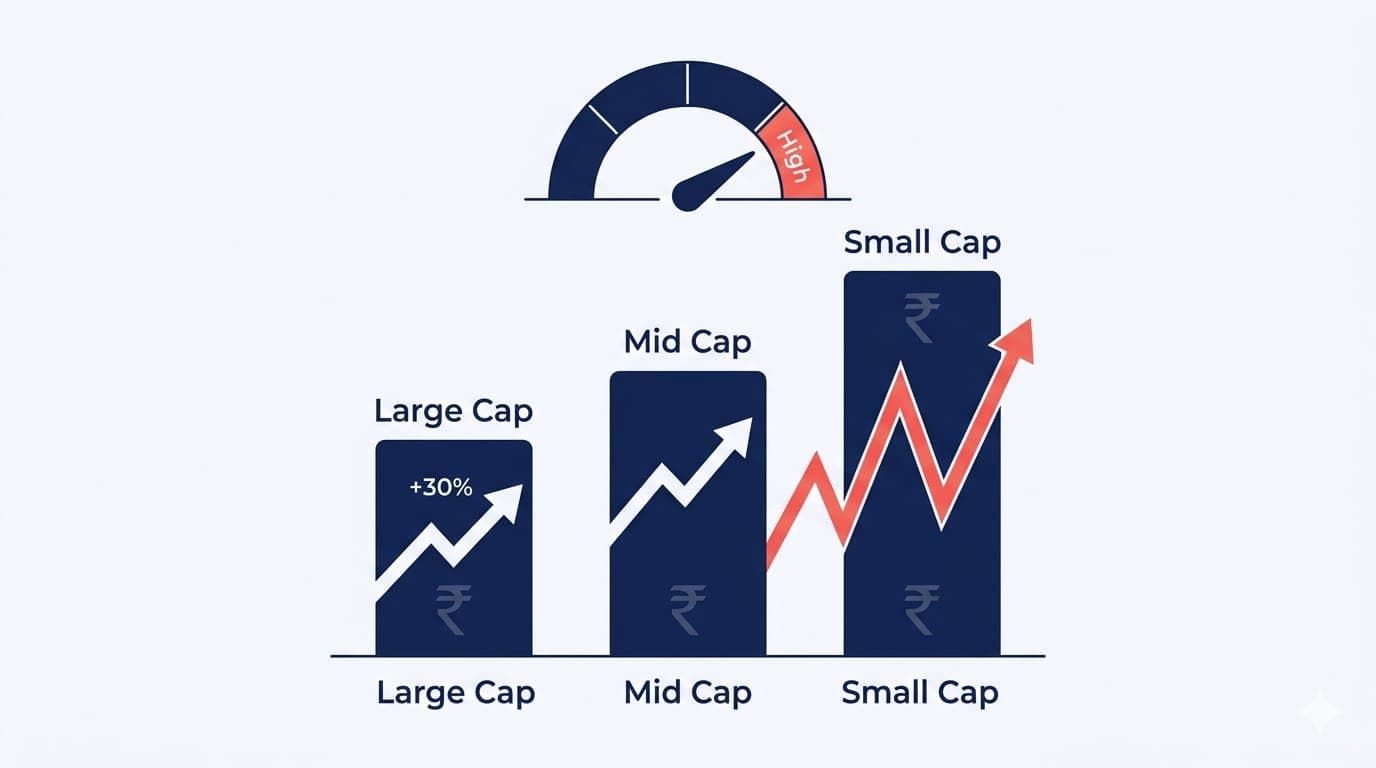
Small cap mutual funds: are you taking the right kind of risk with your money?
|Mutual fund education
Small cap mutual fund AUM in India touched around ₹3.29 lakh crore by end of 2024 — up roughly 33% in just one year. That growth tells us one thing clearly: investors are chasing returns, often without understanding the risks, the right SIP strategies, or how to do proper mutual fund risk analysis.
Key takeaways
At a glance
Question | Short answer |
|---|---|
What is a small cap mutual fund in India? | An equity mutual fund that must invest at least 65% in small cap stocks as defined by SEBI's market cap classification — companies ranked 251 and below by market capitalisation. |
Are small caps suitable for beginners? | Typically no. They require understanding of deep drawdowns, long horizons, and genuine risk capacity — not just risk appetite. |
How risky are they? | Higher market, liquidity, and business risk than large caps. 30–50% drawdowns in correction phases are not uncommon. |
How should I analyse them? | Use rolling returns, downside capture, Sortino ratio, alpha/beta, and active weight calculations — not just point-to-point CAGR. |
SIP or lump sum for small caps? | For most investors, disciplined SIP investment helps average volatility. Lump sum entries near cycle peaks can cause significant regret. |
Is this investment advice? | No. Education only. For personalised advice, consult a SEBI-registered RIA. |
Section 1
What are small cap mutual funds and why are they so popular?
Small cap mutual funds invest primarily in smaller companies that sit below the large and mid cap universe as defined by SEBI. These companies often have higher growth potential — but also higher business and price risk, which is why small cap funds can show sharp ups and downs in short periods.
Double-digit category returns in certain calendar years and strong performance headlines have attracted a flood of SIP investment into these schemes. However, inflows by themselves do not make an investment safe or suitable. The real question is whether small cap exposure fits your risk capacity, time horizon, and overall portfolio plan.
Section 2
How SEBI's market cap rules define small cap mutual funds
Rank 1–100
Large cap
Top 100 companies by market capitalisation
Rank 101–250
Mid cap
Companies ranked 101 to 250 by market cap
Rank 251+
Small cap
All companies ranked 251 and below — minimum 65% allocation required
This structure forces fund managers to stay within the small cap universe, even when valuations look stretched. Once you see small caps through this regulatory lens, you stop viewing them as a shortcut to high returns and start treating them as a separate risk bucket in your mutual fund investment plan.
Section 3
Risk and volatility: what your advisor may not emphasise about small caps
Small cap mutual funds are inherently volatile because the underlying companies are more sensitive to business cycles, interest rates, and liquidity flows. Prices can swing sharply even on low trading volumes — making short-term performance numbers highly unreliable as a decision tool.
Important risk reminder
Drawdowns of 30–50% are not uncommon in small cap correction phases. Before allocating to this category, assess your income stability, emergency fund size, and realistic reaction to seeing your portfolio fall by that amount.
The key distinction is between risk appetite (what you say you can handle) and risk capacity (what your financial situation can actually absorb). Small caps require both to be aligned.
Did you know
As of December 31, 2024, Indian small cap fund AUM stood at about ₹3.29 lakh crore — up roughly 33% year over year, much of it driven by retail SIP inflows chasing recent performance.
Section 4
How to use rolling returns and risk-adjusted metrics for small cap fund analysis
Most investors look at 1-year or 3-year point-to-point returns — which can be very misleading for small caps. A professional mutual fund portfolio analysis always starts with rolling returns, because they show how a fund behaved across multiple entry dates, not just one favourable starting point.
Instead of only looking at 3-year CAGR, check 3-year rolling returns calculated monthly over the last 7 to 10 years. This shows how often the fund beat its benchmark across different market conditions, including corrections.
Metric | Why it matters for small cap analysis |
|---|---|
Rolling returns | Reveals consistency across market cycles — not just one lucky entry date |
Sortino ratio | Focuses specifically on downside volatility — more relevant than Sharpe for volatile categories |
Alpha and beta | Separates genuine manager skill from pure risk-taking — high beta with weak alpha is a warning sign |
Active weight | Shows whether the fund is taking genuinely differentiated bets vs. the small cap benchmark |
Standard deviation | Compares absolute volatility across funds in the same small cap category |
Section 5
SIP investment strategies for small cap mutual funds
SIP investment is one of the most practical ways to get exposure to small cap funds — because it naturally averages entry prices across market cycles. However, not all SIP strategies are equal, and blindly running a high-value SIP into a frothy small cap phase can still hurt you.
Small cap SIPs should be integrated into a broader asset allocation plan — not treated as a separate side-bet. Coordinate your small cap SIPs with large cap, mid cap, and debt fund exposures to maintain your desired overall risk level.
Use step-up SIPs selectively in small caps instead of aggressive lump sum entries at cycle peaks
Set clear rules for when to pause or rebalance — based on portfolio analysis, not market headlines
Coordinate SIPs across small, mid, and large caps to keep your total equity risk intentional and sized correctly
Section 6
Direct vs regular plans in small cap funds: costs matter even more here
Small cap mutual funds typically have higher expense ratios than large cap funds — which makes the direct vs regular plan decision even more critical in this category. Regular plans embed distributor commissions inside the expense ratio, compounding their cost drag year after year.
Direct mutual funds reduce recurring costs, but shift the responsibility of fund selection and risk analysis onto you. Regular plans offer distributor support — but that does not automatically mean objective, conflict-free advice. In a high-risk category like small caps, every extra percentage point of cost directly eats into your risk premium.
Understand the cost difference clearly before deciding. If you choose direct plans, make sure you have the tools and knowledge to conduct your own mutual fund risk analysis independently.
Did you know
In 2024, small cap mutual funds in India drew inflows of about ₹34,223 crore — highlighting how quickly retail money can chase this high-risk category, often near valuation peaks.
Section 7
Goldman Sachs-style techniques you can apply to small cap fund analysis
With experience managing over ₹65,000 crore in AUM using institutional frameworks, the workshop brings professional-grade analysis tools to individual investors — adapted for small cap evaluation specifically.
Active weight calculations: See where a fund is genuinely taking differentiated bets versus the small cap benchmark — versus simply owning the index in different proportions
Alpha and beta decomposition: Separate manager skill from pure risk-taking — a fund with high returns but also very high beta may just be riding market momentum
Factor awareness: Know if your small cap exposure is tilted toward value, momentum, or quality — each behaves very differently in market cycles
Section 8
Behavioural traps: why small cap investors often hurt their own returns
When small caps run up sharply, investors aggressively increase SIPs and lump sums — often near cycle peaks. When the inevitable correction comes, the same investors panic, redeem at low prices, and swear off small caps for years. The problem is not the category alone, but the behaviour around it.
The goal is to turn you from a return-chaser into a process-driven investor. That shift alone can have more impact on your wealth than picking the "best" small cap fund in any single year.
Common biases in small cap cycles include recency bias (expecting recent strong returns to continue), herd behaviour (investing because everyone else is), and overconfidence (underestimating how painful 40% drawdowns actually feel when they happen to your money).
Section 9
Building a balanced portfolio that includes small cap mutual funds
Small cap mutual funds should be a satellite, not the core, of most investors' portfolios. In a sound portfolio construction framework, small caps sit on top of a more stable core of large cap, flexi cap, and suitable debt funds — adding growth potential without dominating the risk profile.
Key questions to answer before allocating to small caps
Do you need small cap exposure at all given your goals and time horizon?
What percentage allocation is sensible for your risk profile — always finalise in coordination with a SEBI-registered RIA
How often will you review and rebalance, so small caps do not accidentally dominate your portfolio after a strong rally?
The goal is not to remove risk — which is impossible in small caps — but to take risk that is intentional, sized properly, and monitored with a clear process.
Section 10
Live mutual fund workshop: learn to analyse small caps like a professional
The Master Mutual Funds Workshop is a live, 2.5-hour interactive session for investors serious about financial education. It covers mutual fund mechanics, market cap-based fund selection, performance analysis, and portfolio construction — with worked examples on small cap funds specifically.
Step-by-step mutual fund selection guide with case studies including small cap funds
Hands-on risk analysis using rolling returns, Sortino ratio, and practical portfolio analysis checklists
Discussion on direct vs regular plans and how to think about costs in high-risk categories
Live Q&A — ask questions in real time and see Goldman Sachs-style techniques applied to real-world examples
The workshop is backed by a money-back guarantee, priced at ₹249, with limited seats per batch to maintain interaction quality. Bonus materials — including advanced implementation notes — are available for a limited time.
Everything covered is educational only. For personalised small cap allocation decisions, always consult a SEBI-registered investment advisor who can align your exposure with your unique goals and risk profile.
Conclusion
Small caps: take the right risk, not the trending risk
Small cap mutual funds can play a useful role in a long-term investment plan — but only if you treat them as a high-risk, high-volatility component that requires serious risk analysis and disciplined portfolio construction. Chasing past returns or copying someone else's allocation without understanding the underlying risk is the fastest route to unnecessary stress and potential loss.
The tools exist to analyse small caps the way professionals do — rolling returns, Sortino ratio, alpha/beta, and active weight calculations. Use them. Build the skill. And always work with a SEBI-registered advisor to personalise your small cap exposure to your actual financial situation.
enjoyed this article?
explore more insights on building wealth.