SIP vs lump sum: what smart mutual fund investors do differently (backed by real data)
SIPs delivered 14.71% CAGR vs lump sum's 12.95% in a 10-year large cap study — but the real question isn't which is "better". Learn when each strategy works, how to use rolling returns & Sortino ratio to compare them, and how to blend both for smarter goal-based investing.
SIP vs lump sum: what smart mutual fund investors do differently (backed by real data)
CashFlowCrew.in|Mutual fund education
In a 10-year review of large cap mutual funds, SIPs delivered an average CAGR of about 14.71% while lump sum investments in the same funds averaged around 12.95%. That small-looking gap can translate into lakhs over time — which is exactly why the SIP vs lump sum question matters so much for your mutual fund investment decisions.
14.71%
SIP average CAGR (10-year large cap study)
12.95%
Lump sum average CAGR (same funds, same period)
₹2.89L cr
FY2025 total SIP inflows
Key takeaways
At a glance
Question | Short answer |
|---|---|
Core difference? | SIP spreads investments over time, reducing timing risk. Lump sum deploys everything on one date, magnifying both gains and losses. |
Which is "better" long term? | Returns often converge over very long periods. SIPs tend to offer better risk-adjusted returns and behavioural benefits. Context and discipline matter more than the label. |
Can I mix both? | Yes. Many investors use SIPs for regular investing and add lump sums during market corrections as part of a written plan. |
Does the choice change for direct vs regular plans? | No — SIP vs lump sum is separate from direct vs regular. But direct plan investors need stronger independent analysis skills. |
Is this investment advice? | No. Education only. For personalised advice, consult a SEBI-registered RIA. |
Section 1
SIP vs lump sum basics: what you are really choosing
When you compare SIP vs lump sum, you are not just choosing a payment method — you are choosing how you handle market volatility and your own behaviour. A SIP invests a fixed amount at regular intervals. A lump sum deploys a larger amount on a single date.
SIP works well when…
You have regular salaried income
You want to remove timing pressure
You need to build a long-term habit
Markets are uncertain or volatile
Lump sum can make sense when…
You receive a bonus, inheritance, or FD maturity
Valuations are reasonable and horizon is long
You understand drawdown risk emotionally
Earlier compounding start is the priority
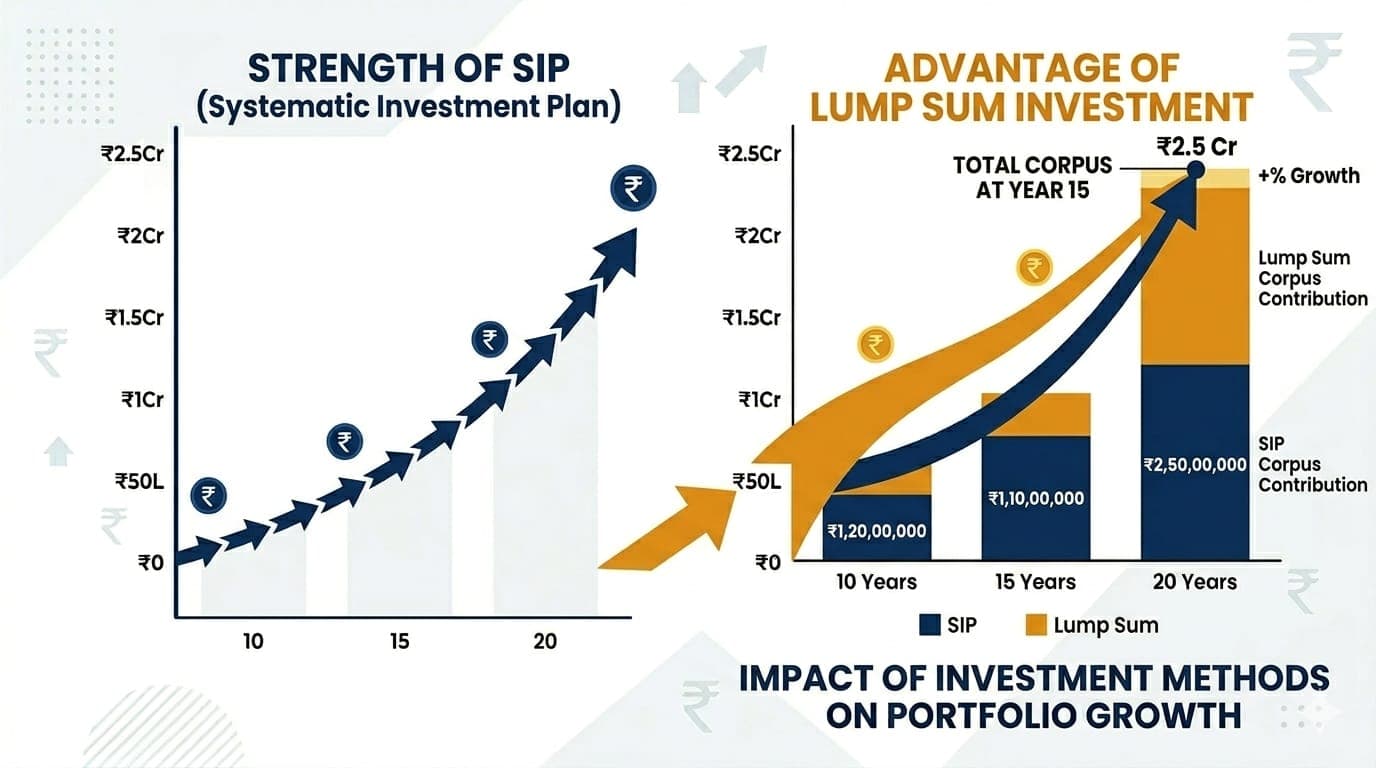
Over a 30-year period from 1995 to 2025, a monthly SIP grew to about ₹3.38 crore while a disciplined annual lump sum on dips strategy reached roughly ₹3.9 crore — with IRRs tightly clustered between 12.41% and 12.48%. The lesson: consistency and time in the market matter more than perfectly timing entries.
Section 2
How SIPs actually work: rupee cost averaging and behaviour
A SIP investment strategy uses rupee cost averaging. You invest the same rupee amount each month, buying more units when markets are down and fewer when markets are high. Over time, this smooths your entry price and reduces regret about "buying at the top."
FY2025 SIP inflows were around ₹2.89 trillion, with SIP assets at about ₹13.35 trillion and more than 81 million contributing SIP accounts. That is not a niche trend — it reflects how a large portion of India saves and invests today.
The behavioural edge of SIPs
SIPs are a behavioural tool as much as an investment tool. When markets fall, it is psychologically hard to put a large lump sum to work — but a pre-set SIP continues automatically, helping you buy low without overthinking. In practice, many investors end up doing better with SIPs than with their irregular, emotion-driven lump sum entries.
Section 3
What a lump sum strategy really implies for your risk
When you invest a lump sum, you accept full market risk from day one. If you invest just before a correction, your portfolio can show sharp notional losses early — even if the long-term outcome is still fine. That early pain is why many investors feel anxious with lump sum entries, even when earlier compounding theoretically favours them.
How to make lump sum decisions more systematic
Look at valuation ranges for the Nifty or Sensex as context — not as a precise timing tool
Check historical drawdowns of your selected funds to understand potential downside before committing a large amount
Consider splitting a large lump sum into 3 to 4 tranches over 6 to 12 months — a practical middle ground
Build your emergency fund first, then decide on core asset allocation before deploying any lump sum
Did you know
FY2024 SIP inflows were nearly ₹2 lakh crore, with SIP assets around ₹10.71 lakh crore and roughly 8.4 crore SIP accounts active — highlighting how dominant SIPs have become in real Indian investor behaviour.
Section 4
Risk-adjusted returns: the metric most people ignore in SIP vs lump sum
Investors usually ask "which gives higher returns?" A better question is: "which gives better risk-adjusted returns for my situation?" Professional mutual fund risk analysis rarely stops at raw CAGR — it evaluates how much risk you took to achieve that return.
Tool | What it reveals in the SIP vs lump sum debate |
|---|---|
Rolling returns | Shows how returns vary for different start dates — critical for comparing strategies without cherry-picking a single lucky entry point |
Sortino ratio | Focuses on downside volatility — tells you how much "good" return you earned per unit of "bad" volatility |
Alpha and beta | Alpha = excess return over benchmark after risk adjustment; beta = sensitivity to market moves. Both reveal whether a fund choice justified the strategy |
Max drawdown | Shows worst historical portfolio fall — helps you decide whether you can emotionally sustain a lump sum entry |
A strategy with slightly lower returns but much smoother drawdowns might actually be better for you — because you are more likely to stay invested long enough for compounding to do its work.
Section 5
How professionals compare SIP vs lump sum in portfolio analysis
The workshop walks participants through actual data comparisons of SIP vs lump sum over different market phases. The goal is not to "declare a winner" — but to help you build a fund selection and strategy process you can stick with.
Techniques you get to practice
Comparing SIP vs lump sum using 10-year and 15-year rolling returns across different categories — large cap, flexi cap, short duration debt
Calculating Sortino ratios to see which funds and strategies handle downside risk better
Computing alpha, beta, and active weights to understand whether a fund manager is genuinely active or hugging the benchmark
Everything covered is purely financial education. No stock or fund tips, no personalised advice. For specific scheme selection and portfolio construction, consult a SEBI-registered RIA.
Section 6
Real-world data: how SIP investors are actually investing today
In February 2024, SIP inflows touched about ₹191.86 billion in a single month. By September 2024, monthly SIP inflows were around ₹245.09 billion — continuing a 43-month streak of steady inflows into equity mutual funds. In June 2025, SIP contributions reached ₹27,269 crore, up 5.2% from March.
As of March 2025, about 33% of regular plan SIP assets and 19% of direct plan SIP assets belonged to SIP accounts older than 5 years — indicating that more investors are treating SIPs as genuine long-term commitments.
But SIPs are not always linear
In January 2025, about 61.32 lakh SIPs were discontinued. In December 2025, around 45 lakh SIPs were stopped while 56.18 lakh new ones were registered. This churn shows exactly why psychological comfort and strategic clarity matter. If a strategy is not emotionally sustainable, it will not work — even if it looks excellent in a spreadsheet.
Did you know
In a 30-year test (1995–2025), a monthly SIP grew to about ₹3.38 crore while a disciplined annual lump sum on dips reached roughly ₹3.9 crore — with IRRs tightly clustered around 12.4–12.5%. Consistency beats timing.
Section 7
Direct vs regular mutual funds: does it change the SIP vs lump sum decision?
These are two separate decisions. SIP vs lump sum is about when and how you invest. Direct vs regular is about which plan you choose and how much you pay in ongoing costs. You can run SIPs or lump sums in either plan type.
Direct plans have lower expense ratios — but require you to take on more responsibility for fund selection and risk analysis. If you choose direct, you need to be comfortable reading scheme documents, understanding fund categories, and using metrics like alpha, beta, and risk-adjusted returns independently.
If you rely on a distributor for guidance, a regular plan can be acceptable — provided you understand the cost you are paying and can evaluate whether the ongoing service justifies it.
Section 8
Building SIP investment strategies like a professional
Instead of asking "is SIP better than lump sum?", ask "what SIP investment strategies work best for my goals?" That shift puts you in control. Professionals define clear objectives, risk budgets, and monitoring rules for every strategy.
Key elements of a robust SIP plan
Clear goal and horizon for each individual SIP — not one SIP for everything
Defined risk level — such as maximum acceptable drawdown — based on your actual comfort, not theory
Fund shortlisting rules — minimum track record, consistent rolling returns, reasonable Sortino ratio
Review schedule — typically once a year, focused on whether the fund still fits your thesis
Section 9
Using portfolio analysis to decide when to add lump sums
SIPs handle regular investing, but surplus cash moments arise — bonuses, matured FDs, inherited amounts. The question is whether to lump sum, stagger, or park in debt and gradually move to equity.
Start with overall asset allocation. If equity weight is significantly below your target after a market correction, a partial lump sum into equity funds may be justified — as long as you understand the risks. If equity is already overweight after a rally, additional lump sums may not fit your plan.
Blending SIP and lump sum
For many investors, the practical answer is a blend: a core SIP framework plus rules-based lump sums during deep corrections or allocation gaps. Keep decisions systematic and tied to a written plan — not driven by fear during crashes or greed during rallies.
Section 10
Compliance, money-back guarantee, and why education comes first
Mutual funds are market-linked products that carry risk, including risk of capital loss. Past performance of SIPs or lump sums does not guarantee future results. All content here is for financial education and follows SEBI guidelines.
The live, interactive workshop covers rolling return analysis, Sortino ratio comparison, alpha/beta calculations, scheme document reading, and mutual fund selection frameworks — all using real sample portfolios. A money-back guarantee is offered within a specified window if you feel the session did not add value to your financial education.
Seats are limited to maintain interaction quality. For personalised portfolio construction, tax planning, and specific scheme selection, always work with a SEBI-registered investment advisor.
Conclusion
SIP vs lump sum is not a fight — it is a choice of process
SIP vs lump sum is not a fight with a single winner. It is a choice between two different ways of entering the same market. SIPs excel at discipline, rupee cost averaging, and emotional comfort. Lump sums can start compounding earlier when used thoughtfully as part of an overall asset allocation plan.
What matters more than the label is the process behind your decision. When you combine solid financial education, practical mutual fund risk analysis, and structured portfolio thinking, you no longer fear volatility the same way — and you use SIP and lump sum consciously to move closer to financial freedom, one informed decision at a time.
enjoyed this article?
explore more insights on building wealth.