SIP calculator explained: the one tool most mutual fund investors underuse
December 2025 SIP assets hit ₹16.63 lakh crore — but most investors use SIP calculators to just guess, not plan. Learn how to use a SIP calculator for goal-based planning, how to combine it with rolling returns & risk analysis, and how to simulate step-up SIP strategies.
December 2025 SIP assets touched about ₹16.63 lakh crore — over one fifth of the entire mutual fund industry. Monthly SIP contributions that same month reached approximately ₹31,001 crore. With so much money flowing through SIPs, a simple SIP calculator can be the difference between guessing your financial future and planning it with clarity.
Key takeaways
At a glance
Question | Short answer |
|---|---|
What is a SIP calculator used for? | Estimates the future value of your SIP investment based on monthly amount, tenure, and expected return — so you can plan goals before investing. |
Does it guarantee returns? | No. It is an educational projection tool. Returns in mutual funds are market-linked. For personalised advice, consult a SEBI-registered RIA. |
Can it help with fund selection? | Indirectly — pairing it with risk analysis like rolling returns and Sortino ratio helps you compare realistic scenarios across different fund categories. |
Can it handle step-up SIPs? | Yes in concept. You can model higher contributions over time and test how annual step-ups change your projected corpus. |
What does a calculator miss? | Real market volatility, expense ratio differences between direct and regular plans, and the behavioural discipline needed to stay invested through downturns. |
Section 1
What is a SIP calculator and why it matters for your mutual fund investment
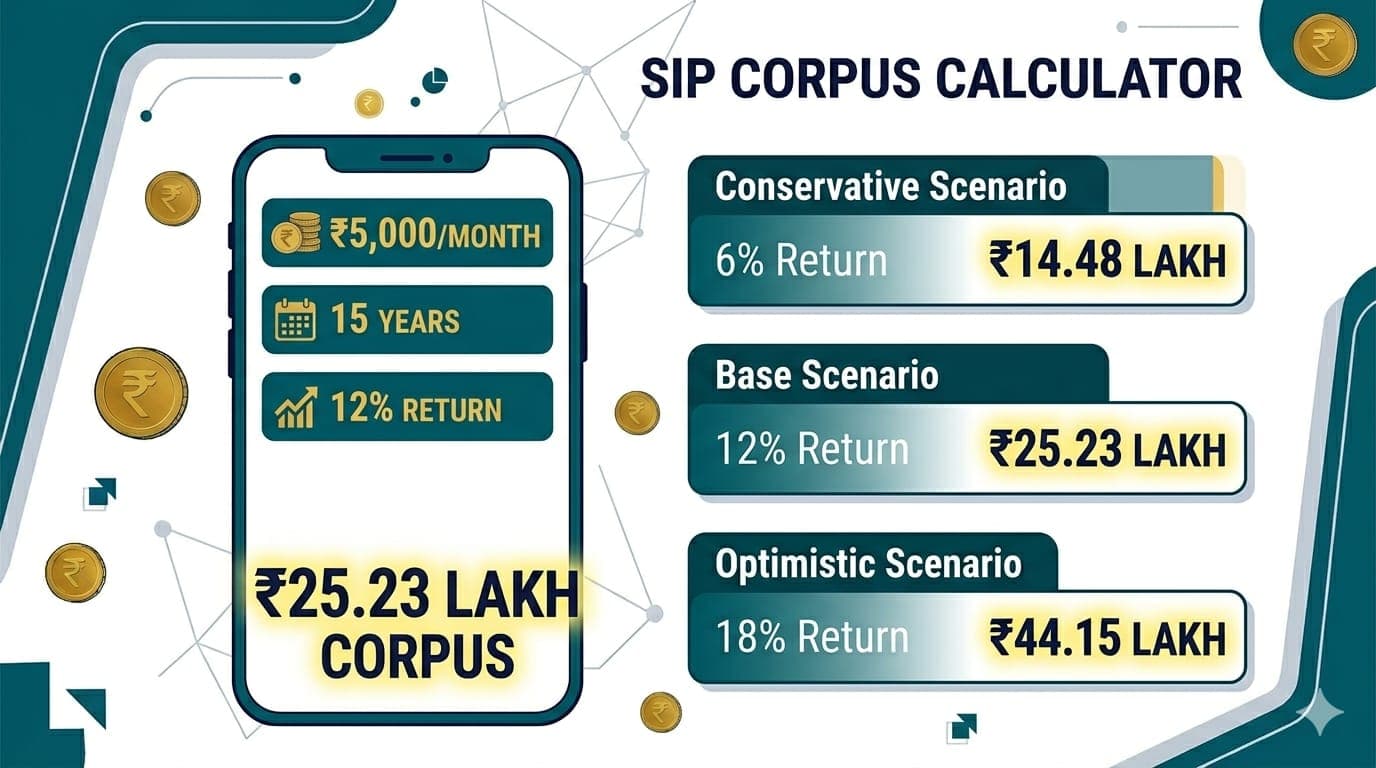
A SIP calculator shows you how much wealth your monthly investments can potentially create over time. You enter your monthly SIP amount, the number of years, and an assumed rate of return — and the calculator estimates the future value of your mutual fund investment.
For many investors, this is the first moment when numbers replace guesswork. Instead of hoping your SIP will be "enough" for retirement or your child's education, you see a clear projection and can adjust your amount or tenure accordingly. This is the foundation of serious goal-based financial planning.
Section 2
How a SIP calculator works: the math behind your monthly investments
Most online SIP calculators use the future value of an annuity formula — compounding each SIP instalment at the assumed rate of return for its remaining tenure, then adding all instalments together.
Core inputs
Monthly SIP amounte.g. ₹3,000 to ₹25,000
Investment tenuree.g. 10, 15, or 20 years
Expected annual returne.g. 10–12% for equity (as an assumption only)
Always run multiple scenarios — conservative, base, and optimistic return assumptions — so your planning is not dependent on a single number. This is exactly how institutional portfolio teams approach projections.
Section 3
Using a SIP calculator for goal-based planning
The real power appears when you link the calculator to specific goals. Instead of vaguely "investing for the future", start with a target: "I need ₹50 lakh for my child's education in 15 years" or "I want a ₹3 crore retirement corpus in 25 years." Then reverse-engineer the process.
1
Enter an assumed return range based on your fund category and risk profile
2
Adjust the SIP amount until the calculator shows a corpus close to your target
3
Check if the required monthly amount fits your budget — or whether a step-up SIP would bridge the gap
Did you know
As of July 2024, roughly 9 crore SIP accounts existed in India — up from 8.4 crore in March 2022, with contributions rising about 56% over two years. Goal-based SIP planning has never been more relevant for Indian investors.
Section 4
SIP calculator vs real-life returns: where risk analysis comes in
A SIP calculator uses a single return input — but real markets never deliver a straight line. That is why SIP calculator use must be connected to proper mutual fund risk analysis. You need to respect risk, not just chase projected numbers.
Tool | What it adds to SIP calculator projections |
|---|---|
Rolling returns | Shows how returns actually behaved across multiple time windows — not just one point-in-time assumption |
Sortino ratio | Focuses on downside volatility — reveals how painful the journey might feel when markets drop |
Alpha and beta | Compares a fund's performance and sensitivity vs its benchmark — tests whether calculator inputs are realistic for this fund |
When you combine these techniques with SIP projections, you stop looking only at "how much" you might accumulate — and start understanding "how bumpy" the journey could be. That is how professionals approach portfolio analysis.
Section 5
SIP calculator and SIP investment strategies you can simulate
Most investors limit themselves to plain vanilla SIPs. A calculator lets you test different strategies before committing — a simple habit that improves decision-making more than any hot tip.
Standard SIP
Same amount every month for a fixed tenure — the simplest baseline to start with
Step-up SIP
Increase your SIP by 10–15% each year to keep pace with income growth — significantly boosts final corpus
Short vs long tenure
Compare a 5-year SIP with a 15-year SIP — compounding differences are often surprising and motivating
SIP pause / restart
See how a 1–2 year break affects the final corpus — makes the cost of pausing SIPs during market falls concrete
Section 6
Direct vs regular mutual funds: what your SIP calculator does not show
A normal SIP calculator rarely differentiates between direct mutual funds and regular plans. Yet the expense ratio gap between these two options makes a meaningful difference to your final corpus over long horizons.
Use the calculator with a slightly lower assumed net return if you are considering regular plans with embedded distributor commissions
Use a higher net return assumption for direct mutual funds where those commissions are removed
Always verify expense ratios — even a 0.5% annual cost difference compounded over 20 years is substantial
Our role is to teach you the questions to ask and the numbers to check. For personalised advice on which plan suits your specific situation, consult a SEBI-registered investment advisor.
Section 7
From SIP calculator to full portfolio analysis: a step-by-step flow
A SIP calculator gives you a snapshot for one goal or one fund. Serious investors combine this with structured mutual fund portfolio analysis to see the bigger picture.
1
Use the SIP calculator for each major goal and note the required SIP amount
2
List existing mutual fund schemes and map which SIP is going where — match each to a specific goal
3
Perform basic mutual fund risk analysis using rolling returns, alpha, beta, and Sortino ratio for each core fund
4
Check active weight — how much your portfolio deviates from the benchmark in sectors and market caps
5
Revisit your SIP plan to align it with your risk capacity, not just your return expectations
Did you know
December 2025 monthly SIP contributions in India touched about ₹31,001 crore — underscoring how critical proper SIP planning tools and risk analysis frameworks have become for everyday investors managing large cumulative investments.
Section 8
Building your own mutual fund selection guide around the SIP calculator
Many people start with the SIP amount they can afford and then randomly pick popular funds. Flip the process: build a fund selection framework first, then use the SIP calculator once you are clear about which scheme categories fit your risk profile.
Fund category and role: Large cap, flexi cap, or aggressive hybrid — each has different expected return ranges and volatility to use in your calculator
Risk-adjusted returns: 5 to 10-year Sortino ratio and rolling return consistency before deciding what return to assume
Cost impact: Expense ratio comparison between direct and regular plans — adjust your calculator inputs accordingly
Portfolio fit: Sector exposure, market cap mix, and active weight — ensures the fund won't duplicate what you already hold
Section 9
Inside the live mutual fund workshop: turning calculator users into confident investors
The flagship 2.5-hour live, interactive mutual fund workshop treats the SIP calculator as a starting point — not the end. Real-time demos, live Q&A, and hands-on exercises build the thinking behind the numbers.
Live concept breakdown of NAV, SIP vs lump sum, and asset allocation — all linked back to practical calculator use
Goldman Sachs-grade techniques — rolling returns, Sortino ratio, alpha, beta, active weight — explained in plain language
Case studies and portfolio analysis exercises you can repeat every year on your own
Money-back guarantee — if you attend and feel you did not get value, a refund can be requested as per workshop policy
Currently available at a discounted fee of ₹249 (original price ₹999) for a limited time. Portfolio audit checklists and mutual fund selection templates are included as time-bound bonus materials.
Section 10
Compliance, disclaimers, and how to use the SIP calculator responsibly
A SIP calculator uses hypothetical returns — real market returns can be higher or lower, often in ways a calculator cannot predict
No calculator can eliminate market risk in equity mutual funds — equity always carries inherent volatility
Our examples never guarantee profits, risk-free returns, or specific performance numbers
All discussions are aligned with SEBI guidelines and are meant to improve your understanding — not replace professional advice
Treat the SIP calculator as a planning compass, not a promise machine. Used with that mindset, it helps you make better, more grounded decisions and stay on track even when markets are volatile.
Conclusion
A planning compass — not a promise machine
A SIP calculator is a simple tool — but when combined with proper mutual fund risk analysis, a thoughtful fund selection guide, and disciplined portfolio review, it becomes a powerful ally on your journey toward financial freedom. It translates monthly savings into concrete future numbers, reveals trade-offs clearly, and keeps you honest about what it will actually take to reach your goals.
Use the SIP calculator to plan, use financial education to understand risk, and lean on SEBI-registered advisors for personalised guidance when you need it. That combination gives you both clarity and confidence.
enjoyed this article?
explore more insights on building wealth.