Mutual fund schemes explained: how smart investors actually choose, analyse and track their funds
22 crore mutual fund folios and counting — yet most investors are still guessing. Learn how to choose, analyse and track mutual fund schemes like a professional using rolling returns, Sortino ratio, alpha/beta and a 5-minute selection checklist.
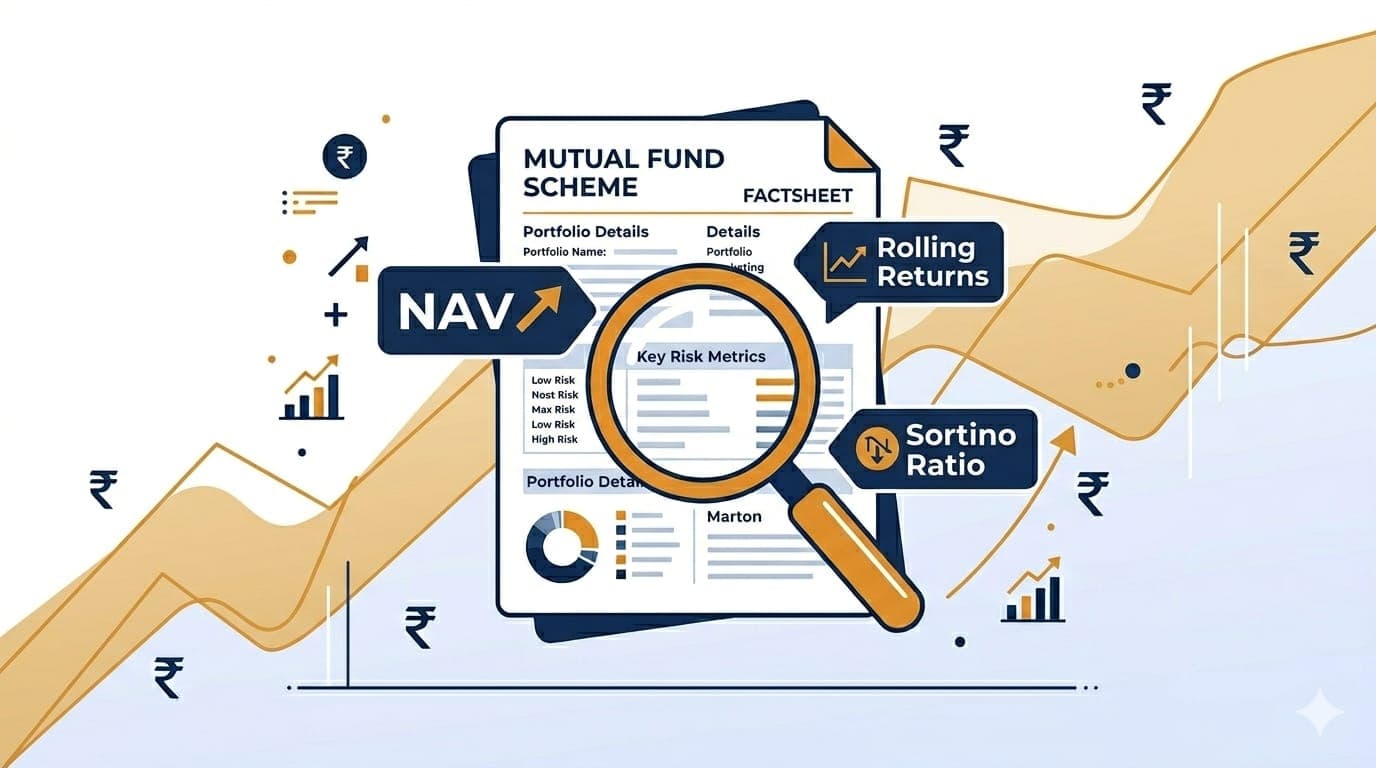
Mutual fund schemes explained: how smart investors actually choose, analyse and track their funds
CashFlowCrew.in|Mutual fund education
Open-ended mutual funds added 5.13 crore folios in 2024, taking the total to 22.02 crore by November — yet most investors are still guessing when it comes to scheme selection, SIP strategies and risk analysis. This guide walks you through how professionals think about mutual fund investment so you can make decisions with clarity instead of confusion.
Key takeaways
At a glance
Question | Answer |
|---|---|
What is a mutual fund scheme? | A pooled investment where many investors contribute money that a professional fund manager invests in equity, debt, or hybrids following a stated objective. |
Direct vs regular mutual funds? | Direct plans are bought without distributor commissions and have a lower expense ratio. Regular plans are routed through intermediaries with commission embedded in costs. |
How do professionals analyse schemes? | Beyond returns — rolling returns, risk-adjusted ratios like Sortino, drawdowns, alpha/beta, and active weight relative to the benchmark. |
Is this advice or education? | Everything here is for educational purposes only. For personalised advice, SEBI guidelines require you to consult a SEBI-registered RIA. |
Can a 2.5-hour workshop actually help? | The session focuses on actionable tools — a 5-minute scheme health check, portfolio analysis templates, and SIP strategies you can apply immediately. |
Section 1
What exactly is a mutual fund scheme and why it matters for your wealth
At its core, a mutual fund scheme is simple: many investors pool their money, a professional team manages it according to a clearly defined strategy, and everyone shares profits and losses proportionally. In reality, how schemes are structured, priced, and regulated under SEBI guidelines can make the difference between building solid long-term wealth and quietly leaking returns through hidden costs and poor risk management.
Types of mutual fund schemes you will encounter
Equity schemes: Invest primarily in stocks, usually for long-term growth.
Debt schemes: Invest in bonds and money market instruments for income and stability.
Hybrid schemes: Mix equity and debt in different proportions.
Sectoral and thematic funds: Focus on specific themes or industries — and carry concentrated risk.
As the mutual fund industry AUM approaches ₹68 lakh crore, the choice of schemes is exploding. Without a clear selection framework, it is easy to pick options that do not align with your time horizon or risk capacity.
Section 2
How mutual fund schemes work: NAV, units and cash flows
When you invest, you do not buy stocks directly — you buy units of the scheme at a price called Net Asset Value (NAV), which reflects the market value of the underlying portfolio after expenses.
Key mechanics every investor should know
NAV calculation: Market value of securities minus liabilities, divided by total units outstanding.
Entry and exit: Purchases and redemptions happen at end-of-day NAV for open-ended schemes.
Expense ratio: Annual cost charged to manage the fund, expressed as a percentage of AUM.
Growth vs IDCW: Growth options reinvest returns for compounding; IDCW distributes them — with different tax implications.
Direct vs regular plans: Same portfolio, different expense ratios due to distributor commissions.
Section 3
SIP investment strategies: using mutual fund schemes for long-term goals
SIP contributions were around ₹25,000 crore per month as of late 2024 — showing how central SIP investment is to the mutual fund growth story. But instead of just "starting a SIP", you should learn how to pick schemes, decide contribution amounts, and monitor performance using rolling returns and risk-adjusted metrics.
Practical SIP tactics
How to stagger SIP dates versus lump sum investments in volatile markets
When to increase SIP amounts and when to pause or reduce them
How to combine equity and debt schemes inside a goal-based plan
Using portfolio analysis to rebalance periodically instead of reacting emotionally
Section 4
Mutual fund selection: a professional-style checklist for retail investors
Most investors either overcomplicate fund selection with too many ratios, or oversimplify it by chasing star ratings. A balanced framework mirrors how institutional teams think — but in a retail-friendly way. Use this 5-minute health check repeatedly across schemes to build a repeatable process.
1
Clarity of mandate: Does the scheme's objective, universe, and benchmark make sense to you?
2
Consistency: Use rolling returns over multiple periods instead of point-to-point returns.
3
Risk-adjusted returns: Look at Sortino ratio and downside risk, not just average returns.
4
Costs: Compare expense ratios between direct and regular plans — the gap compounds significantly over time.
5
Portfolio fit: Check overlaps with existing schemes using portfolio analysis tools before adding a new fund.
Did you know
Equity-oriented mutual funds in 2024 saw net inflows of ₹3.53 lakh crore — making them one of the strongest magnets for retail money among all investment products that year.
Section 5
Mutual fund risk analysis: looking beyond star ratings
Two schemes with similar past returns can have very different risk profiles. Without proper risk analysis, you might be holding a portfolio that looks comfortable in a bull market but behaves very differently when volatility increases.
Key risk metrics you should understand
Standard deviation: Measures overall volatility of returns across periods.
Sortino ratio: Focuses on downside volatility — a more practical measure for long-term investors.
Maximum drawdown: Shows the worst peak-to-trough fall over a given period.
Beta: Indicates how sensitive the scheme is to movements in its benchmark index.
Once you start looking at risk-adjusted returns instead of just raw returns, many flashy schemes suddenly look less attractive — and steady performers begin to stand out for the right reasons.
Section 6
Portfolio analysis: how to read what your mutual funds are really doing
Owning multiple mutual fund schemes does not automatically create diversification. We often see portfolios with ten or more equity funds that behave almost exactly like the same index. Portfolio analysis helps you see what you actually own — not what you think you own.
What mutual fund portfolio analysis covers
Checking stock and sector overlaps across all your schemes
Comparing portfolio weights with the benchmark to estimate active bets
Aligning asset allocation with your risk profile and time horizon
Creating a simple, maintainable rebalancing plan instead of frequent churning
Section 7
Applying Goldman Sachs-style techniques to Indian mutual fund schemes
With over 4 years of Goldman Sachs experience working with global portfolios and risk systems across more than ₹65,000 crore equivalent AUM, the workshop brings institutional thinking to retail investors — translated into simple checklists and tools you can maintain independently.
Technique | What it tells you | Why it matters |
|---|---|---|
Rolling returns | Consistency across market cycles | Reveals funds that look good only in specific periods |
Alpha and beta | Skill vs market exposure | Separates genuine outperformance from beta rides |
Sortino ratio | Downside risk quality | Focuses on the volatility that actually hurts you |
Active weights | Real portfolio bets vs benchmark | Shows where the manager is actually taking a view |
Did you know
Total open-ended mutual fund AUM rose 20% in 2025 — from ₹66.66 lakh crore to ₹79.98 lakh crore — reflecting how much investor capital now rides on mutual fund scheme decisions.
Section 8
Direct vs regular mutual funds: cost, convenience and control
Over long periods, the cost difference between direct and regular plans can materially impact your final corpus — especially in equity schemes where holding periods are often 10 years or more.
Aspect | Direct plan | Regular plan |
|---|---|---|
How you invest | Directly with AMC or online platforms | Through distributor or agent |
Expense ratio | Lower — no embedded commission | Higher — includes distributor commission |
Advice included | You manage or hire a SEBI-registered RIA separately | Distributor may guide, but is not an RIA |
Control and transparency | Higher — more DIY oriented | Convenience focused |
Section 9
Inside the live mutual fund workshop: curriculum, pricing and money-back guarantee
All the concepts above are covered in a live, interactive 2.5-hour workshop designed for working professionals and serious beginners. The session covers mutual fund mechanics, fund selection, performance analysis, portfolio construction, and the behavioural side of staying invested.
₹249₹999Limited time
What you will master in 2.5 hours
Mutual fund mechanics: How equity mutual funds operate, how NAV is calculated, how pooled investing really works.
Fund selection: Using a mutual fund selection guide and 5-minute health check.
Performance analysis: Rolling returns, Sortino ratio, alpha and beta in practice.
Portfolio construction: Building a goal-linked portfolio with a rebalancing strategy.
Hidden costs: Expense ratios, impact of direct vs regular, and exit loads that quietly erode returns.
The workshop is live and interactive — ask questions in real time and see examples tailored to Indian mutual fund schemes. You also receive a certificate of completion to add to your financial education journey.
Section 10
Bonuses and money-back guarantee
A clear money-back guarantee is offered within the stated window — if you attend, apply the frameworks, and still feel you did not get value, a refund can be requested. Bonus materials are available for limited cohorts and may expire as the curriculum is updated.
Mutual Fund Starter Guide
Structured introduction for beginners
Quick Hacks to Improve Returns
Cost control and better risk management
Monthly Portfolio Audit Checklist
Keep schemes aligned with your goals
Portfolio Analysis Templates
Tools for hands-on portfolio analysis
SIP Strategies for Beginners
Risk-adjusted returns and discipline
Resource List from Class
All websites discussed, to learn independently
All content is within an educational framework. Consult a SEBI-registered RIA for personalised scheme-level advice, allocation decisions and tax planning for your unique situation.
Conclusion
From guesswork to confident, informed investing
Mutual fund schemes now sit at the centre of most Indian investors' wealth journeys. The real gap is not access — it is education. Too many investors start SIPs or switch schemes without understanding how mutual fund investment, risk analysis, and portfolio construction actually work together.
Whether you join the workshop or study independently, the goal is the same: to become a confident, informed investor who uses mutual fund schemes thoughtfully in the pursuit of financial freedom — while respecting risk and regulatory guidelines at every step.
enjoyed this article?
explore more insights on building wealth.