Mutual fund risk analysis: what your financial advisor never told you about picking safer funds
Most investors check returns but ignore risk — until it's too late. Learn how mutual fund risk analysis using rolling returns, Sortino ratio, alpha & beta can help you pick safer funds and stay invested confidently. No finance degree needed.
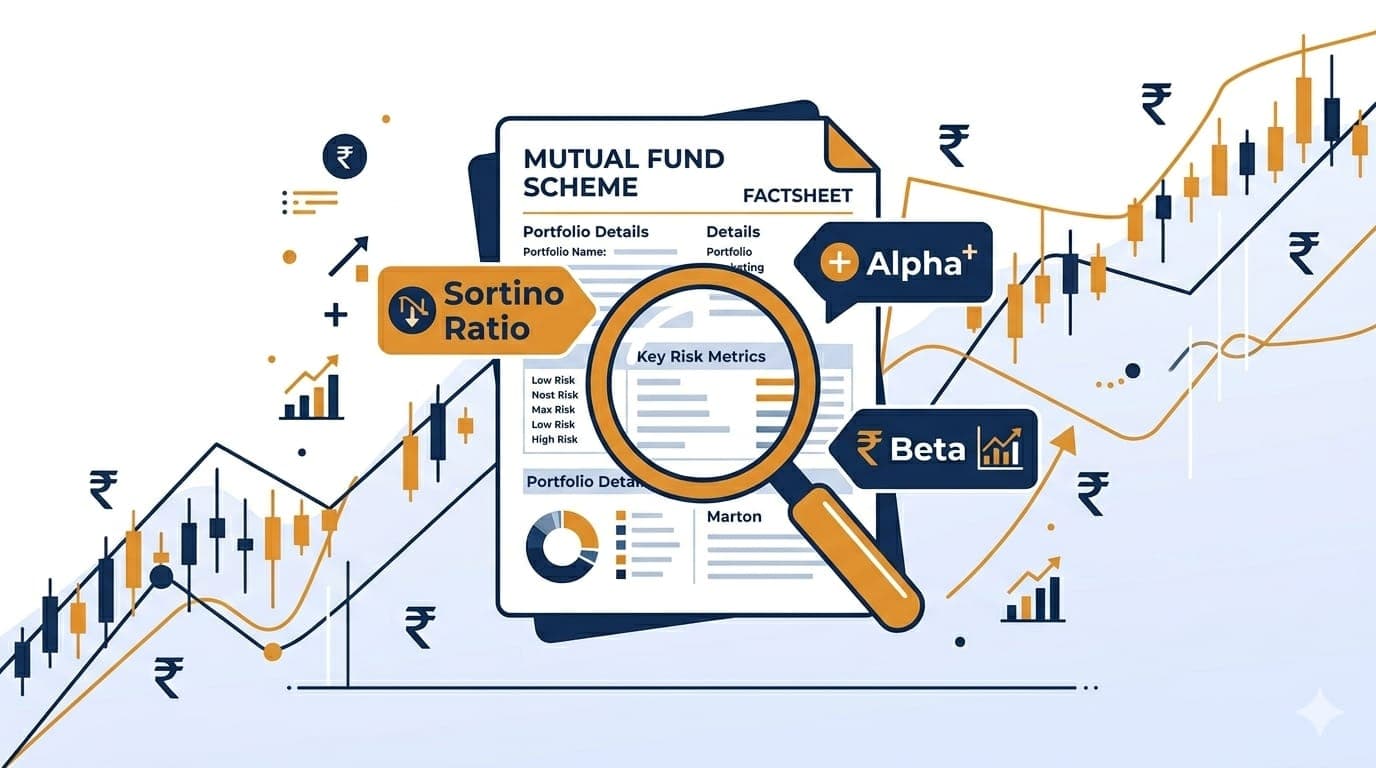
Most investors focus on returns but ignore risk until markets get rough. Money market funds accounted for 18.6% of ETF and mutual fund assets as of June 30, 2024 — showing how many investors quietly retreat to "safety" when they feel uncertain. Mutual fund risk analysis is the skill that helps you stay invested confidently instead of reacting out of fear.
Key takeaways
At a glance
Question | Short answer |
|---|---|
What is mutual fund risk analysis? | A structured way to measure how much a fund can lose, how volatile it is, and whether returns consistently justify that risk across market cycles. |
How is it different from basic performance tracking? | Basic tracking looks at past returns. Risk analysis uses rolling returns, alpha, beta, and Sortino ratio to judge the quality of returns — not just their size. |
Why does it matter for SIP investors? | Even with disciplined SIPs, poor risk control can leave you overexposed to one sector, style, or fund house. Regular portfolio analysis fixes that. |
Can beginners learn this without a finance degree? | Yes. The concepts can be explained using real fund examples in plain language — no jargon needed. |
Is this investment advice? | No. Everything here is financial education only. For personalised recommendations, consult a SEBI-registered RIA. |
Do you cover direct vs regular mutual funds? | Yes — including how cost differences quietly compound over time and affect risk-adjusted returns. |
Section 1
What mutual fund risk analysis really means for your money
Mutual fund investment is often sold as "set and forget" — but risk does not forget you. Risk analysis answers three core questions: how much can this fund lose, how likely is that loss, and is the return worth that risk?
Rather than chasing hot past returns, the goal is to examine how a fund behaves across market cycles, interest rate regimes, and different volatility periods — and connect that directly to your goals and time horizon.
Section 2
Why risk analysis matters even more for SIP investors
Many investors assume that if they run a SIP long enough, risk will somehow "average out". In reality, the quality of funds you choose matters as much as the discipline of investing every month.
Through proper risk analysis, you understand drawdown patterns and volatility — so you do not panic-stop SIPs at exactly the wrong time. The goal is to treat SIPs as a systematic wealth-building plan, supported by data-driven fund selection rather than guesswork.
Section 3
Core techniques: rolling returns, Sortino ratio, alpha and beta
To learn mutual funds seriously, you must go beyond single-period returns. These are the key techniques that professional teams use every day to judge risk:
Rolling returns: Instead of looking at 3-year or 5-year returns once, roll the period across many start dates to see how often the fund did well or badly across different market conditions.
Sortino ratio: Unlike Sharpe, which penalises both upside and downside volatility, Sortino focuses only on downside risk — the kind that actually hurts you.
Alpha and beta: Alpha tells you if the manager added value over the benchmark after adjusting for risk. Beta shows how sensitive the fund is to market moves.
Did you know
Only 33% of active strategies beat their passive rivals in the past year — meaning two out of three active funds did not justify their extra risk and fees.
Section 4
Goldman Sachs-style frameworks applied to Indian mutual funds
Professional teams at firms like Goldman Sachs look at factor exposures, sector tilts, and active weight calculations before deciding whether a fund manager is taking smart risk or just random risk. The idea is not to mimic institutional investors, but to adapt their disciplined thinking to your own portfolio.
Active weight and risk-adjusted returns
Active weights versus the benchmark show what bets the fund is really taking — not what the marketing material says.
Connecting active weights to risk-adjusted returns tells you whether those bets were worth it over time.
Section 5
Direct vs regular mutual funds: risk is not just about volatility
Many investors see direct mutual funds only as a way to save on expenses. But in risk analysis, costs are a risk factor by themselves — higher fees drag down long-term risk-adjusted returns even if the underlying portfolio is identical.
Aspect | Direct plan | Regular plan |
|---|---|---|
Expense ratio | Lower — no distributor commission | Higher — commission embedded |
Risk-adjusted returns | Usually better if gross performance is the same | Usually lower due to cost drag |
Control and responsibility | More control, more DIY responsibility | Less control, advisor-dependent |
A seemingly small extra expense ratio compounds over 10 to 20 years into a large gap in outcomes — even if both options show similar volatility and drawdowns.
Section 6
Mutual fund portfolio analysis: connecting individual funds to your goals
Fund-level risk analysis is only half the job. Portfolio analysis checks how all your funds behave together, and whether your overall risk actually matches your goals and risk appetite.
Simple portfolio checks every investor should run
Equity vs debt vs hybrid allocation compared to your time horizon
Market cap mix — large vs mid vs small — and what that means for volatility
How many funds you actually need to diversify versus over-diversify
Hidden concentration in sectors, themes, or a single fund house
Section 7
Live mutual fund workshop: format, pricing, and money-back guarantee
The flagship mutual fund workshop is a live, interactive 2.5-hour session focused on practical risk analysis and fund evaluation skills — not sales pitches.
Standard
₹249
Core session with worksheets and frameworks
Premium
₹999
Extended Q&A, additional resources and bonus materials
Step-by-step walk-throughs of risk metrics using real fund examples
Live Q&A to clarify doubts about your own mutual fund investment decisions
Hands-on worksheets and frameworks for doing your own portfolio analysis later
Money-back guarantee: If you attend live and feel you did not get value, you can request a refund according to the clearly stated terms at registration.
Did you know
Investors added nearly $430 billion of net new assets to money market funds in the 12 months ended June 30, 2024 — reflecting how fear pushes portfolios into low-return assets when risk is not properly understood.
Section 8
SEBI guidelines, compliance, and why we do not give direct advice
All content at CashFlowCrew is positioned as financial education — not personalised investment advice or stock tips. We strongly encourage you to consult a SEBI-registered RIA for advice specific to your financial situation, tax profile, and goals.
Our promise: education first, transparency always. No specific return guarantees, no "sure shot" schemes, and no claims to replace qualified SEBI-registered professionals.
Section 9
Building your own risk-aware mutual fund selection checklist
A big part of financial empowerment is having your own repeatable process — so you are not dependent on random tips or ads. Here is a risk-first checklist to evaluate any fund:
Define your goal and time horizon — short term, medium term, or long term
Filter by SEBI category, then check volatility and maximum drawdowns
Evaluate rolling returns and Sortino ratio, then check alpha and beta
Compare expense ratios for direct vs regular plans and decide accordingly
Assess portfolio overlap with your existing holdings before adding a new fund
Section 10
Bonus materials and learning at your own pace
Sessions are kept small to ensure Q&A stays meaningful. Some bonus materials — advanced case studies and extra SIP strategy templates — are available only for specific batches and may expire when a batch fills.
Limited-time access to bonus case studies on risk-adjusted returns
Downloadable worksheets for mutual fund portfolio analysis
Summary notes and follow-up materials to revisit key ideas after the session
Conclusion
From guesswork to informed decision-making
Mutual fund risk analysis is not a luxury skill for professionals — it is a basic requirement if you care about protecting your capital and reaching financial freedom without constant market anxiety.
With a structured approach to risk-adjusted returns, careful portfolio analysis, and a strong focus on financial education, you can move from guesswork to confident decision-making. For personalised advice, always work with a SEBI-registered advisor who can tailor these concepts to your unique situation.
enjoyed this article?
explore more insights on building wealth.