Mutual fund investment explained: what your financial advisor never told you about building real wealth
Global mutual fund assets hit $29.11 trillion — yet most investors still pick funds using tips and star ratings. Learn how mutual fund investment really works, how to select funds using rolling returns & Sortino ratio, and how to build a goal-linked portfolio with disciplined SIPs.
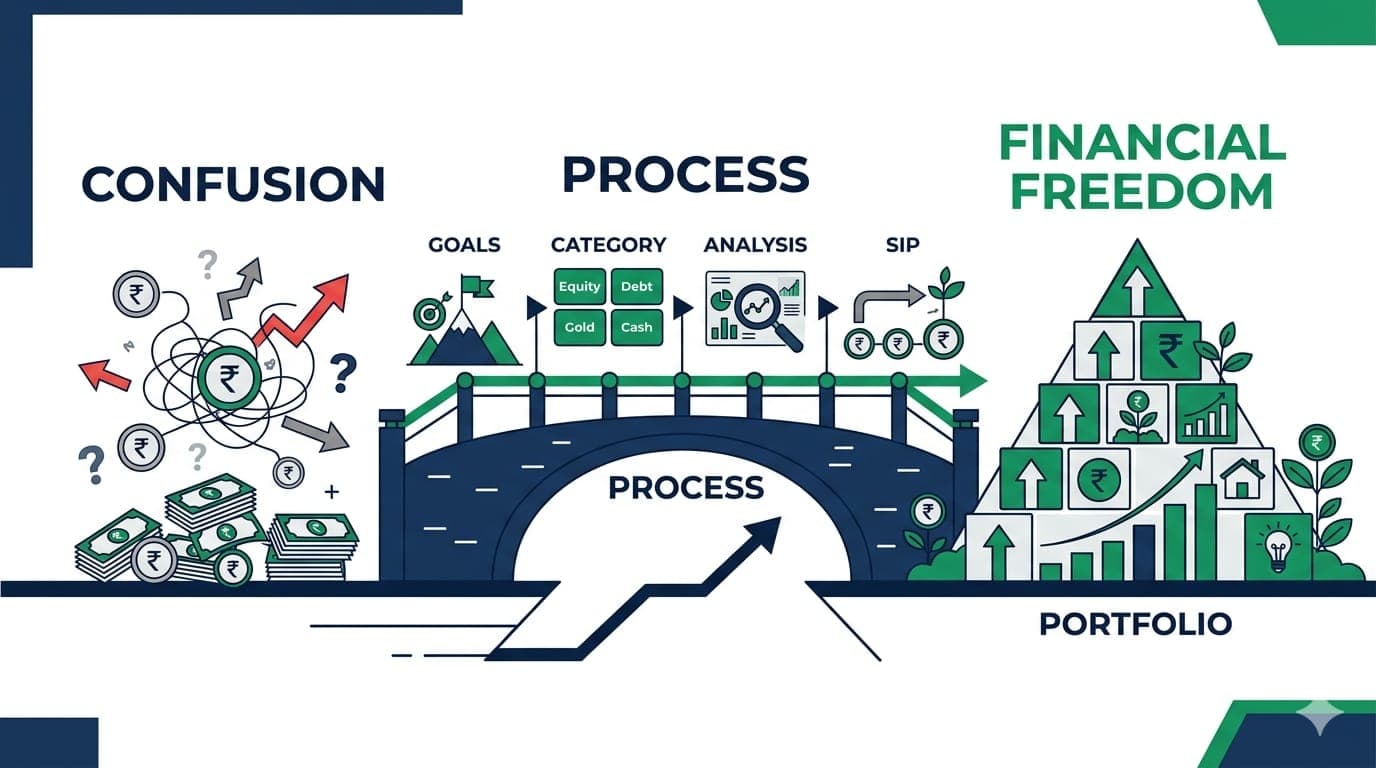
Global mutual fund assets touched around $29.11 trillion in January 2025. Yet most investors still pick funds based on tips, star ratings, or recent performance rather than a clear, data-driven process. Our goal is to help you learn mutual funds the right way — moving from confusion to clarity and building a portfolio that genuinely supports financial freedom.
Key takeaways
At a glance
Question | Short answer |
|---|---|
What is mutual fund investment? | Pooling money with other investors to access diversified portfolios managed by professionals. A core tool for long-term wealth creation when used correctly. |
How do I start SIP investment? | Basic KYC, a bank mandate, and a clear goal-based plan. Focus on disciplined monthly investing rather than timing the market. |
What is the right way to select funds? | Use rolling returns, risk-adjusted returns, alpha/beta, and consistency across market cycles — not just star ratings or last year's performance. |
Direct or regular mutual funds? | Direct plans have lower expense ratios and better long-term outcomes — but require you to handle selection and monitoring yourself. |
Is this investment advice? | No. Education only. For personalised recommendations, consult a SEBI-registered investment advisor (RIA). |
Section 1
What is mutual fund investment and how does it really work?
A mutual fund house collects money from many investors and invests in a basket of securities — stocks, bonds, or a mix. You get units of the fund that represent your share of that pool, professionally managed within SEBI's regulatory framework.
Instead of tracking individual stocks daily, you focus on choosing the right category, risk level, and fund type. For most people, mutual funds are a more practical route to long-term wealth than directly picking dozens of individual securities.
Equity funds: Growth and long-term wealth creation — higher risk, higher potential return
Debt funds: Stability, income, and shorter-term goals — lower risk
Hybrid funds: Balance equity and debt based on your risk appetite
Index / passive funds: Track market indices at low cost — no active stock selection
Section 2
Why most investors struggle with mutual fund selection
Mutual fund selection in practice is where most investors get stuck. We see three recurring problems: portfolios cluttered with funds that look different but hold the same stocks, underestimation of risk, and no use of data tools like rolling returns or risk-adjusted metrics.
Performance chasing
Picking funds only because they topped charts last year — almost always leads to buying near the peak
Ignoring costs
Not comparing expense ratios or understanding the direct vs regular mutual funds difference
No written plan
Investing without clear goals, time horizons, or asset allocation decisions written down
Copying someone else's portfolio
Using another person's allocation as a template without checking if it fits your own situation
Section 3
SIP investment strategies: turning volatility into an advantage
SIP investment is one of the most effective ways to build wealth with mutual funds. Instead of timing the market, you commit to a fixed monthly contribution, benefit from rupee-cost averaging, and build discipline that compounds over time.
Match SIP funds to specific goals — retirement, children's education, a house — not generic "wealth creation"
Align the fund category to your time horizon — longer horizons can typically absorb more equity volatility
Review SIPs annually with basic mutual fund portfolio analysis, not monthly in reaction to market moves
Avoid stopping SIPs during every market fall — corrections are part of the rupee-cost averaging benefit
Section 4
Mutual fund risk analysis: learning to see the full picture
Real risk goes beyond "high, moderate, low" risk labels. It shows up in volatility, drawdowns, concentration, and how a fund behaves in different market regimes. There is also behaviour risk — how likely you are to panic and exit at the worst time.
Metric | What it reveals | Why it matters |
|---|---|---|
Standard deviation and beta | Volatility relative to the market | Sets realistic expectations for day-to-day and crisis NAV swings |
Drawdown analysis | Peak-to-trough falls during crashes | Tests whether you could actually hold through a similar event |
Sortino ratio | Downside volatility specifically | More relevant than Sharpe for investors sensitive to portfolio falls |
Concentration metrics | Top 10 holdings and sector weights | Reveals hidden concentration risk across your "diversified" portfolio |
Did you know
SPIVA U.S. Year-End 2024 shows that 65% of large-cap active funds underperformed the S&P 500 in 2024 — highlighting how hard it is for many "star" funds to beat a simple index after fees are accounted for.
Section 5
Mutual fund portfolio analysis: cleaning up and optimising your holdings
Most investors suffer from too many funds — not too few. Proper portfolio analysis helps you cut noise, remove overlap, and align each fund with a clear role. Think of your portfolio like a team: each player needs a defined position and purpose.
1
Count how many funds you hold in each category and confirm why each one is there
2
Check overlap in holdings across your top 3 equity funds — you may be owning the same stocks multiple times
3
Review risk-adjusted returns of each major fund using rolling returns and Sortino ratio
4
Confirm your overall mix aligns with your risk profile and time horizon — not with what was trending when you started
Section 6
Direct vs regular mutual funds: cost, advice and control
Aspect | Direct mutual funds | Regular mutual funds |
|---|---|---|
Expense ratio | Lower — no embedded distributor commission | Higher — includes commission |
Advice | You take responsibility or hire a fee-only SEBI-registered RIA separately | Guided by distributor or relationship manager |
Control | More control, more effort required | Less effort, but potential conflicts of interest |
Best for | DIY investors who invest in financial education | Investors who prefer hand-holding and are comfortable paying via expense ratio |
We focus on education, not distribution — so we talk openly about cost impact. We do not give specific fund recommendations or replace SEBI-registered advisors.
Section 7
Learning mutual funds with institutional-grade techniques
Most retail investors never access the frameworks that institutional managers use. The goal is to simplify those techniques — not water them down — so you can apply them to your own mutual fund investment decisions.
The lead instructor brings experience managing over ₹65,000 crore in AUM at Goldman Sachs, where risk management, process, and data come before stories. That mindset is integrated into how mutual fund selection and portfolio analysis are taught.
Rolling returns analysis across different time windows and market cycles
Sortino ratio to evaluate how funds handle downside risk specifically
Alpha and beta to separate genuine manager skill from market exposure
Active weight calculations to see how different a fund is from its benchmark — and whether that difference is being rewarded
Did you know
In 2024, only about 33% of active strategies both survived and beat their passive counterparts over 12 months — underscoring why rigorous, data-driven fund selection is critical rather than assuming "active is always worth the fee."
Section 8
Live mutual fund workshop: from confusion to a clear plan
Reading about mutual fund investment is one thing — applying it to your own money is another. The live, interactive mutual fund workshop lets you ask questions in real time, work through examples, and practice techniques with guidance from someone with institutional experience.
Step-by-step mutual fund selection guide using real-world data and publicly available factsheets
How to build and review SIP investment strategies for different goals
Hands-on mutual fund risk analysis using rolling returns, Sortino ratio, alpha, beta
Portfolio clean-up exercises to reduce clutter, overlap, and unintentional risk
Clear money-back guarantee window if the workshop does not add value to your financial education. Content is education only — always aligned with SEBI guidelines, never personal investment advice.
Section 9
How this training fits into your journey to financial freedom
Financial freedom is not about chasing the highest return — it is about having a clear, sustainable plan and the confidence to stick with it through market cycles. Mutual fund investment, combined with disciplined SIPs and periodic portfolio analysis, can be a powerful part of that plan.
What changes once you truly learn mutual funds
You stop depending on tips and start relying on your own structured analysis
You view volatility as a feature to be managed — not a reason to exit and lock in losses
You become intentional about aligning investments with specific life goals and timelines
Section 10
Practical next steps: level up your mutual fund investment skills this week
1
List all your current mutual fund holdings, SIPs, and the goals each is meant to serve
2
Run a basic portfolio analysis for overlap, category mix, and time horizon alignment
3
Identify 2 to 3 key metrics you will always check: rolling returns, Sortino ratio, expense ratio
4
Decide whether to move towards direct mutual funds or stay with regular — and document your reason
5
Enroll in a structured learning path to deepen your understanding with real examples and live guidance
Conclusion
From random tips to a clear, process-driven investment system
Mutual fund investment does not have to be confusing or intimidating. With the right financial education, a clear fund selection guide, and disciplined SIP investment strategies, you can build a portfolio that genuinely supports your journey toward financial freedom.
Professional-grade tools — rolling returns, Sortino ratio, alpha/beta, and active weight analysis — are accessible to individual investors with the right guidance. If you are ready to move beyond random tips and take control of your money, treat your mutual fund decisions with the same seriousness you give your career. The skills you build now will compound over decades.
enjoyed this article?
explore more insights on building wealth.