Mid cap mutual funds: the complete guide to smarter growth investing in India
21 out of 29 mid cap funds beat their benchmark in 2024. But with strong performance comes rising risk and selection mistakes. Learn how to analyse mid cap mutual funds using rolling returns, Sortino ratio & active weights — not just star ratings and recent returns.
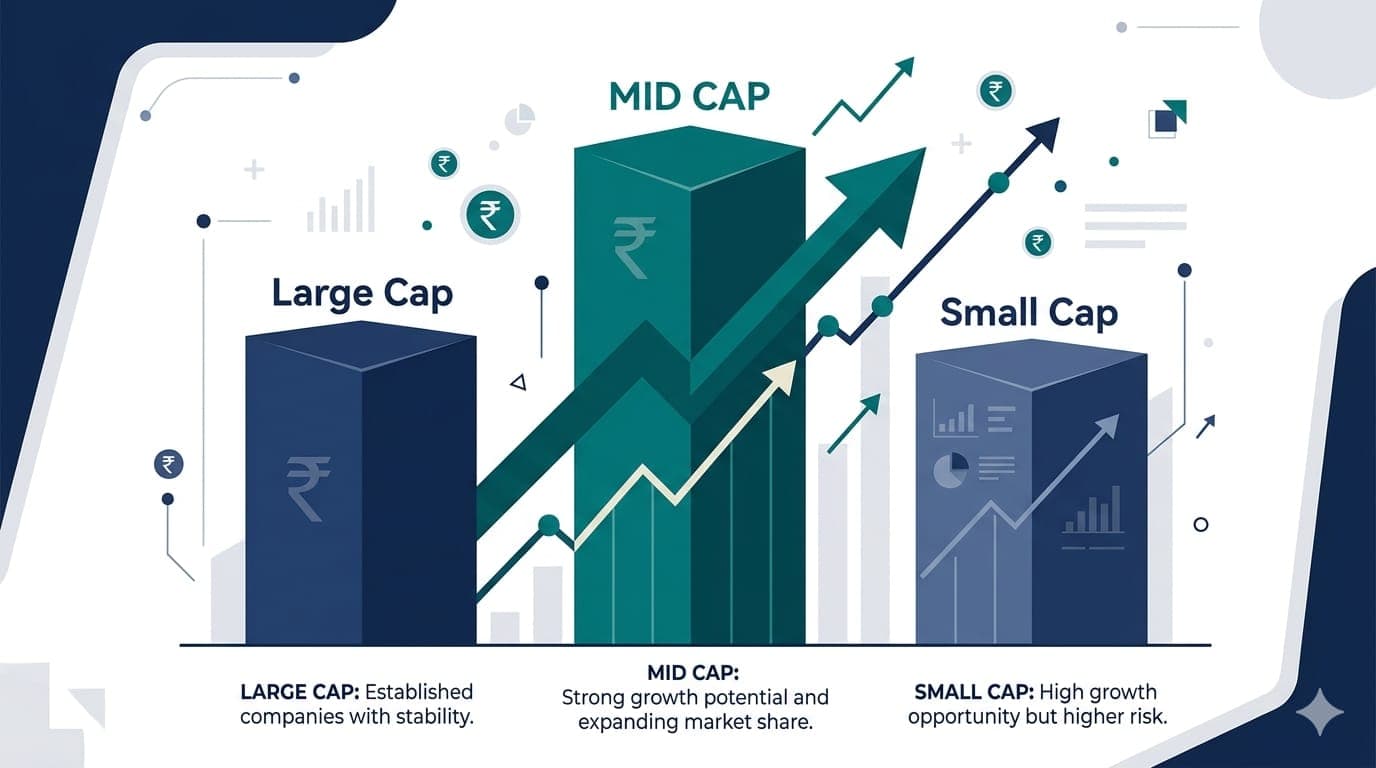
Mid cap mutual funds: the complete guide to smarter growth investing in India
Mutual fund education
Around 16 mid-cap mutual funds delivered more than 30% returns in 2024 out of about 29 funds in the category — and 21 of 29 schemes outperformed their benchmarks (72% hit rate). That kind of performance has pulled a huge number of investors in. But with the opportunity comes sharply rising risk, volatility, and fund selection mistakes.
72%
Mid cap schemes that beat benchmark in 2024
₹14,756 cr
Net inflows, mid cap funds H1 FY25
101–250
SEBI market cap rank range for mid caps
Key takeaways
At a glance
Question | Short answer |
|---|---|
What are mid cap mutual funds? | Equity schemes that invest at least 65% in companies ranked 101 to 250 by market capitalisation as per SEBI's classification. |
Are they suitable for beginners? | They can work with a long horizon and genuine risk awareness. Most investors benefit from structured financial education before adding mid caps. |
How risky compared to large caps? | Higher volatility and drawdowns — 30–40% corrections are not unusual. But also higher long-term growth potential if selected and monitored properly. |
SIP or lump sum for mid caps? | SIP investment helps average out volatility. Combine with periodic portfolio analysis rather than reacting to short-term drawdowns. |
Direct vs regular plans? | Direct plans have lower expense ratios. The right choice depends on your comfort with independent fund selection and analysis. |
Is this investment advice? | No. Education only. Consult a SEBI-registered RIA for personalised recommendations. |
Section 1
What are mid cap mutual funds and why are they so popular?
Mid cap mutual funds are equity schemes that invest mainly in mid-sized companies — ranked between 101 and 250 by market capitalisation as per SEBI's categorisation. They must invest at least 65% of their portfolio in equity and equity-related instruments of mid cap companies.
Investors are attracted because mid caps often have more growth potential than mature large caps, yet are typically less fragile than very small companies. The result is a "sweet spot" of growth and risk — a category that can meaningfully boost long-term portfolio outcomes if handled with discipline and proper analysis, not return-chasing.
Section 2
Risk and reward: are mid cap mutual funds right for you?
Mid cap mutual funds are not low-risk products. Their NAVs can fluctuate sharply during market corrections, and drawdowns of 30 to 40% are not unusual in extreme years. You must align your allocation to mid caps with your time horizon, risk appetite, and financial goals — not with recent performance headlines.
The right approach is to treat mid caps as part of a diversified equity allocation — not the entire portfolio. Before deciding what percentage belongs in mid caps, evaluate your income stability, emergency fund, goal timelines, and realistic emotional response to portfolio falls.
Section 3
How SEBI guidelines shape mid cap mutual fund portfolios
SEBI has clearly defined categories — large cap, mid cap, small cap, multi cap, and flexi cap. For mid cap funds, the minimum 65% allocation to mid cap stocks is mandatory. This regulatory structure means you know what you are getting when you choose a fund from this category, and fund managers cannot silently drift into small caps during bull runs.
All CashFlowCrew programs operate strictly as financial education under SEBI guidelines. We do not provide stock tips or personalised fund recommendations. For advice tailored to your situation, always consult a SEBI-registered investment advisor (RIA).
Did you know
In 2024, 21 mid-cap schemes outperformed their benchmarks while 8 did not — a 72% outperformance rate. But past outperformance does not guarantee future results, which is why rolling returns analysis matters.
Section 4
Risk-adjusted returns: evaluating mid cap mutual funds like a professional
Looking at 1-year or 3-year point-to-point returns can mislead you badly in the mid cap space. Serious professionals rely on tools that reveal how a fund behaves across full market cycles — not just in a single good year.
Metric | What it reveals for mid cap analysis |
|---|---|
Rolling returns | Measures return consistency across multiple overlapping periods — exposes funds that look good only in specific windows |
Sortino ratio | Focuses on downside volatility specifically — more relevant than Sharpe for a volatile category like mid caps |
Alpha and beta | Alpha = excess return over benchmark after risk adjustment; beta = sensitivity to market moves. High beta with weak alpha is a warning sign. |
Active weights | How much the fund deviates from benchmark holdings — low active weight suggests the fund is essentially index-tracking at active fees |
These are the same tools professionals at institutional asset managers use routinely. The goal is not to memorise formulas — but to understand what each metric tells you about a fund manager's skill versus luck.
Section 5
SIP investment strategies for mid cap mutual funds
For most investors, SIP investment is the most practical way to enter mid cap mutual funds. SIPs help you average the cost of buying during both cheap and expensive phases — especially important in a volatile category. But not all SIP strategies are equal.
Practical SIP approaches for mid caps
Fixed monthly SIP with annual portfolio review: Consistent commitment with periodic check on whether the fund still meets your risk-adjusted criteria
Goal-based SIPs: Link each SIP to a specific long-term target — retirement, children's education — with appropriate time horizon
Staggered lump sum + SIP: During high-valuation phases, consider spreading a large sum across 6 to 12 months rather than a single entry
Combine SIPs with periodic mutual fund portfolio analysis — tweak allocations if a fund consistently underperforms its peers on a risk-adjusted basis, not just because it fell in a single quarter.
Did you know
In H1 FY25 (Apr–Sep 2024), mid-cap funds attracted ₹14,756 crore in net inflows. Mid-cap and small-cap funds together drew ₹30,342 crore — signalling strong but potentially concentrated retail enthusiasm.
Section 6
Direct vs regular mutual funds: cost matters a lot in mid caps
Because active management is meaningful in the mid cap space, costs can silently eat into risk-adjusted returns. Direct mutual funds carry lower expense ratios — no distributor commissions embedded. Over long periods, this difference compounds significantly.
Aspect | Direct plan | Regular plan |
|---|---|---|
Expense ratio | Lower — no distributor commission | Higher — includes distributor commission |
Who manages transactions | You handle independently | Distributor or advisor assists |
Best suited for | DIY investors with strong financial education and analysis skills | Investors who value hand-holding and are willing to pay for it |
The decision depends on whether you are comfortable conducting your own fund selection and portfolio analysis. Whatever you choose, know exactly what you are paying and why — especially in a category like mid caps where every basis point of cost matters over 10 to 15 year SIP horizons.
Section 7
Goldman Sachs-style thinking for mid cap mutual fund selection
The workshop curriculum is built by an instructor with experience managing over ₹65,000 crore in assets using institutional-grade processes — including methods used at firms like Goldman Sachs. Those professional techniques are adapted into step-by-step frameworks that individual investors can apply to mid cap funds.
The goal is not to overwhelm you with jargon, but to build your skills so you can read a mid cap fund factsheet like a professional — even if you are investing as an individual with a monthly SIP of ₹5,000.
In sessions, you see how professionals evaluate sector weights, top holdings concentration, factor exposures, and active weights versus benchmarks. This level of analysis filters out funds that are quietly hugging the index from those that are genuinely active and worth their fees.
Section 8
Live, interactive mutual fund workshop: learn mid caps in real time
Reading articles is a good start — but many investors gain real confidence only when they can ask questions, see live examples, and practice with guidance. The live, interactive mutual fund workshop covers mid cap funds in depth using real rolling return charts, Sortino ratio comparisons, and alpha/beta dashboards — all using publicly available fund data.
What you can expect inside the workshop
Step-by-step mutual fund selection guide with case studies on mid cap funds specifically
Live Q&A — clarify concepts on the spot with an instructor who has managed ₹65,000 crore+ in AUM
Bonus worksheets and portfolio analysis templates for your future fund reviews
Practical exercises on rolling returns, Sortino ratio, and active weight analysis you can run yourself
Section 9
Money-back guarantee, limited-time bonuses, and ethical disclaimers
The workshop comes with a clear money-back guarantee — attend, participate, and if you feel you did not gain practical value for your mutual fund investment journey, a refund can be requested within the specified window.
Limited-time bonus materials — additional case studies, checklists, and portfolio tracking templates — are offered for a specific window to encourage action on financial education rather than indefinite postponement. Terms and expiry are always stated upfront.
All content is educational — not investment, tax, or legal advice
No specific mid cap mutual funds are recommended for you personally
For personalised advice, consult a SEBI-registered investment advisor (RIA)
Section 10
Building your own mid cap mutual fund playbook
The most powerful outcome of good financial education is independence. Instead of relying on sales pitches or one-line tips, you build a repeatable process you can use every year to review existing funds and evaluate new ones.
Mutual fund risk analysis
Rolling returns, Sortino ratio, max drawdown — run annually and after major market events
SIP investment strategy
Goal-linked SIPs with clear rules for pause, step-up, or rebalancing — not emotion-driven decisions
Fund selection guide
Alpha, beta, active weight, expense ratio, and track record checks before adding any new fund
Portfolio analysis calendar
Scheduled reviews — not reactive churning — to keep allocation intentional and goal-aligned
You remain fully in control of how you apply these tools — ideally with input from a SEBI-registered advisor for any personalised allocation or tax decisions.
Conclusion
Mid caps: a powerful category that rewards process, not hype
Mid cap mutual funds can play a powerful role in your equity portfolio — but only if you approach them with the right expectations, risk awareness, and selection framework. The recent surge in flows and impressive short-term returns are only one side of the story. Disciplined mutual fund risk analysis, risk-adjusted returns, and ongoing portfolio review are the other side — the one many investors still ignore.
Build the skills to navigate this category responsibly, within SEBI guidelines, and with full respect for the role of qualified advisors. An evidence-based playbook for mid cap investing is one of the most valuable tools on your path to long-term financial freedom.
enjoyed this article?
explore more insights on building wealth.