Equity mutual funds in India: the complete guide your advisor never had time to explain
FY2025 equity mutual fund inflows hit a record ₹4.17 lakh crore — yet most Indian investors still pick funds using tips and star ratings. Learn how equity mutual funds really work, how to analyse them using rolling returns & Sortino ratio, and how to build a goal-linked equity portfolio.
Equity mutual fund inflows in FY2025 alone touched a record ₹4.17 lakh crore — with total equity AUM reaching roughly ₹30.57 lakh crore by end of 2024. India now has more than 15 crore equity fund folios. Yet most investors still rely on tips, random videos, or half-explained advice instead of a structured way to analyse risk, returns, and suitability.
Key takeaways
At a glance
Question | Key insight |
|---|---|
What are equity mutual funds in India? | Schemes that invest at least 65% in equities and equity-related instruments — suited for long-term goals with higher risk than debt or hybrid funds. |
How should beginners learn mutual funds? | You need structured financial education — not random tips. Cover mechanics, selection, and risk analysis techniques used by professionals. |
SIP or lump sum for equity funds? | SIP helps average out volatility and build discipline. Lump sum works when valuation and risk are assessed well. Both have a place in a smart plan. |
How do I choose the right equity fund? | Use a structured selection guide: category fit, cost (direct vs regular), portfolio quality, and metrics like alpha, beta, and Sortino ratio — not past returns alone. |
Is this investment advice? | No. Education only. For personalised recommendations, always consult a SEBI-registered investment advisor (RIA). |
Section 1
What are equity mutual funds in India and why do so many investors prefer them?
Equity mutual funds are schemes that invest at least 65% of their assets in equities and equity-related instruments. Instead of buying individual stocks, you pool money with thousands of investors and a professional fund manager builds and manages a diversified portfolio for you.
For Indian investors aiming at long-term goals like retirement, children's education, and financial freedom, equity funds offer a practical route to participate in India's growth story — combining diversification, professional management, and relatively low ticket sizes.
Section 2
Types of equity mutual funds in India you should know before investing
By market cap
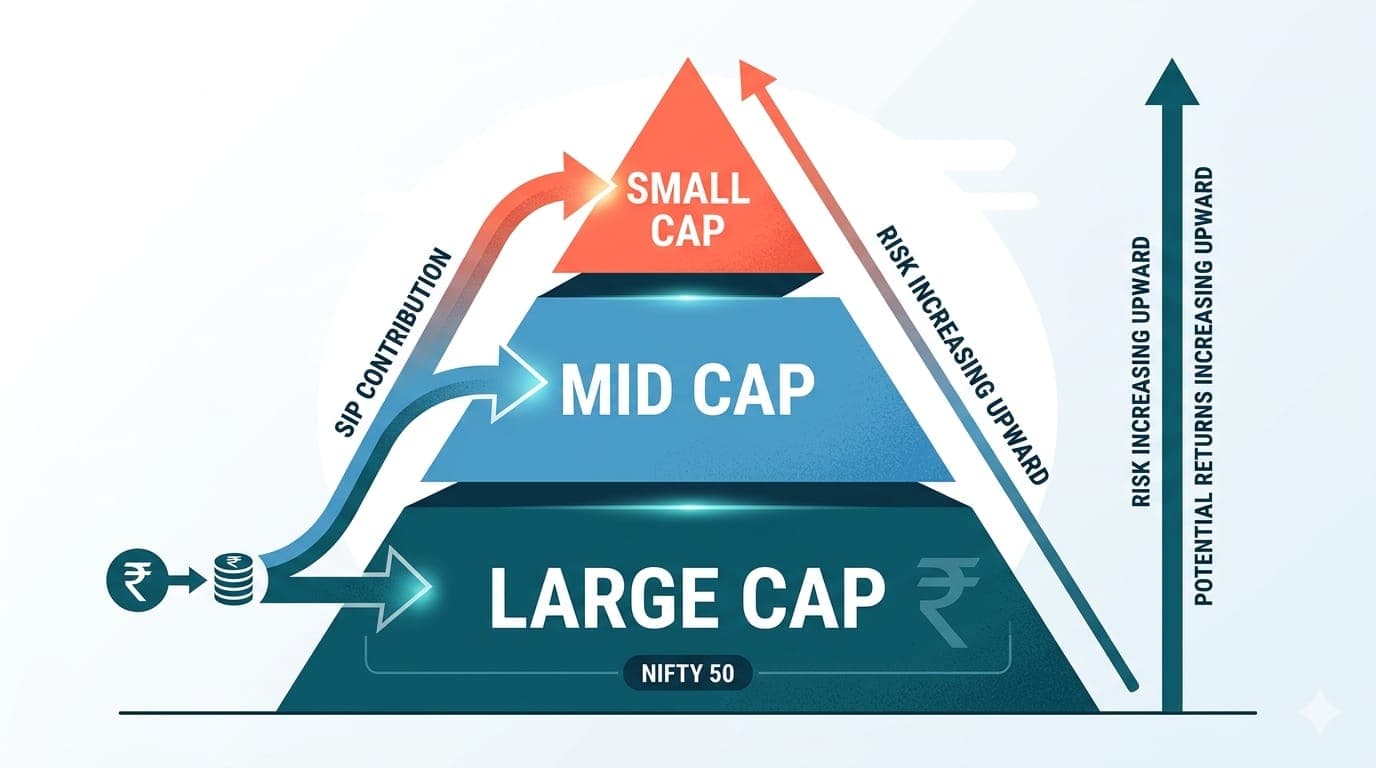
Large cap funds
Top 100 companies — more stable, moderate return potential
By market cap
Mid cap funds
Companies ranked 101–250 — higher growth potential and higher volatility
By market cap
Small cap funds
Beyond top 250 — very high volatility, require long holding periods
By market cap
Flexi cap / multi cap
Invest across market caps — useful for all-weather exposure
By strategy
Value / growth / focused
Different stock-picking philosophies with varying risk-return profiles
By objective
ELSS (tax saving)
Section 80C benefit with 3-year lock-in — equity fund at core
Always match the fund type to your goal horizon and risk profile — not to short-term performance. A proper selection process starts from your needs, then moves to categories, and only then to individual schemes.
Section 3
How equity mutual funds actually work: behind the NAV you see on your app
When you invest in an equity fund, your money buys units at the prevailing NAV. The fund manager invests the pooled corpus in a basket of stocks. Every market movement, every dividend, and every expense entry affects the NAV. Knowing this helps you judge volatility correctly and avoid unnecessary panic during corrections.
How inflows and redemptions affect cash levels and portfolio deployment timing
Impact of expense ratios and hidden costs on long-term wealth creation
Why two funds with similar portfolios can show very different results due to cost and execution differences
Section 4
SIP investment in equity mutual funds: discipline over prediction
December 2025 SIP inflows touched a record ₹31,002 crore and SIP assets crossed ₹16.63 lakh crore — clear evidence that investors are choosing discipline over market timing. A SIP helps you invest a fixed amount regularly, buying more units when markets fall and fewer when they rise.
Key SIP investment strategies for equity funds
Align each SIP to a specific goal with a clear time horizon — 10+ years for retirement, 7–10 years for education
Use rolling returns analysis to understand past SIP experience across different start dates — not just "since inception"
Review SIP allocation annually through a structured portfolio analysis checklist — not monthly in reaction to markets
Did you know
In 2024, equity mutual fund inflows were ₹3.94 lakh crore, helping total equity AUM reach roughly ₹30.57 lakh crore — about 40% higher year-on-year, reflecting a structural shift toward equity investing in India.
Section 5
Direct vs regular mutual funds: costs, commissions, and control
Aspect | Direct mutual funds | Regular mutual funds |
|---|---|---|
Expense ratio | Lower — no distributor commission | Higher — includes distributor commission |
Who manages selection | You, or a fee-only SEBI-registered advisor | Distributor or relationship manager usually guides |
Control and transparency | Higher — true cost visible | Lower — cost bundled with service |
Best for | Investors willing to invest in financial education | Those who prefer hand-holding and are comfortable with higher cost |
Over long periods, even a 0.5% to 1% lower expense ratio can create a large difference in final corpus. But lower cost is useful only if you have the knowledge and process to do your own fund selection and risk analysis. For specific scheme selection, consult a SEBI-registered RIA.
Section 6
Professional techniques to analyse equity mutual funds: beyond star ratings
Most investors stop at star ratings and recent returns. That is not how professionals analyse equity funds. With experience managing more than ₹65,000 crore in AUM using Goldman Sachs-style frameworks, the approach is always data-driven and risk-aware.
Metric | What it reveals for equity fund analysis |
|---|---|
Rolling returns | Consistency across multiple time windows — not just a single convenient period |
Sortino ratio | Penalises downside volatility specifically — more relevant for equity investors than Sharpe |
Alpha and beta | How much return is skill-based vs market-driven — tests genuine active management value |
Active weight | Where the fund manager is taking differentiated bets vs benchmark — reveals real conviction |
Once you learn to read these numbers, you stop chasing "top funds this month" lists and start thinking like an analyst. This is where financial education creates real confidence.
Section 7
Building an equity mutual fund portfolio aligned to your goals
Buying random equity mutual funds is not a strategy. You need a clear plan on how many funds to hold, which categories to use for each goal, and how to manage overlap. A mix of large cap and flexi cap funds may be better suited for a medium-risk investor than an all-small-cap portfolio — even if small caps look exciting short-term.
Map each investment to a clear goal and time horizon before choosing a category
Ensure diversification across market caps, sectors, and fund houses to reduce concentration risk
Limit overlapping funds to keep monitoring manageable — 5 to 8 equity funds is often enough
Use a periodic portfolio analysis checklist to review and rebalance annually
Did you know
In 2024, approximately 80% of open-ended equity mutual funds beat their benchmarks by October 31 — highlighting the importance of understanding how to evaluate active fund performance, not just assume "index is always better."
Section 8
Mutual fund selection guide: a repeatable 5-step process
1
Define the objective: growth, income, tax saving, or a specific goal and time horizon
2
Choose the right category as per SEBI definitions — large cap, flexi cap, ELSS, etc.
3
Screen for costs: compare direct vs regular plans and expense ratios
4
Evaluate performance and risk using rolling returns, Sortino ratio, drawdowns, alpha, and beta
5
Study the portfolio: sector allocation, top holdings, active weight, and consistency with stated strategy
This framework is for learning and due diligence. For any final decision on which fund to buy or sell, work with a SEBI-registered investment advisor who understands your full financial picture.
Section 9
Goldman Sachs-style analysis applied to Indian equity mutual funds
What separates a casual investor from a serious one is the depth of analysis. Institutional techniques, simplified for individual investors without requiring complex software:
Setting up a basic but effective fund screening system for your personal watchlist
Looking at factor exposures — value, quality, momentum — indirectly through portfolio holdings data
Understanding how active weight and tracking error influence the potential for outperformance, along with the associated risk
With the right templates, public data, and a clear process, you can significantly upgrade how you look at equity mutual funds in India — without making it a full-time job.
Section 10
Live mutual fund workshop: learn, analyse, and practise in real time
The live, interactive mutual fund workshop is structured from basics to advanced implementation — covering hidden costs, performance analysis beyond basic returns, behavioural finance, and portfolio construction with real-world examples.
Step-by-step training on mutual fund risk analysis and portfolio analysis using real-world examples
Ready-to-use tools — Monthly Portfolio Audit Checklist and Portfolio Analysis Templates
Bonus materials including "Quick Hacks to Improve Portfolio Returns" and "Essential Mutual Fund Strategies for Beginners" — available for limited time
Money-back guarantee if you feel the workshop did not add value — conditions stated transparently during registration
Important: All sessions follow SEBI guidelines and are purely educational. We do not take commissions on any products and do not provide personalised investment advice.
Conclusion
From information overload to structured action
Equity mutual funds in India are no longer a niche product — they are at the centre of how millions of households are planning for financial freedom. The challenge is not access, but understanding. With so many categories, schemes, and opinions, what you really need is a clear framework, solid financial education, and the confidence to apply professional tools like rolling returns, Sortino ratio, alpha, beta, and active weight in a practical way.
Treat financial education as an investment in yourself. Whether you learn with a live workshop or independently, always stay aligned with SEBI guidelines and consult a qualified RIA for personalised decisions that account for your complete financial situation.
enjoyed this article?
explore more insights on building wealth.