ELSS tax saving: the most underused tax benefit smart investors rely on
Most investors waste Section 80C on EPF and insurance — missing ELSS, the only 80C option that builds equity wealth with just a 3-year lock-in. Learn how to evaluate ELSS using rolling returns, Sortino ratio & risk analysis instead of chasing last year's top fund.
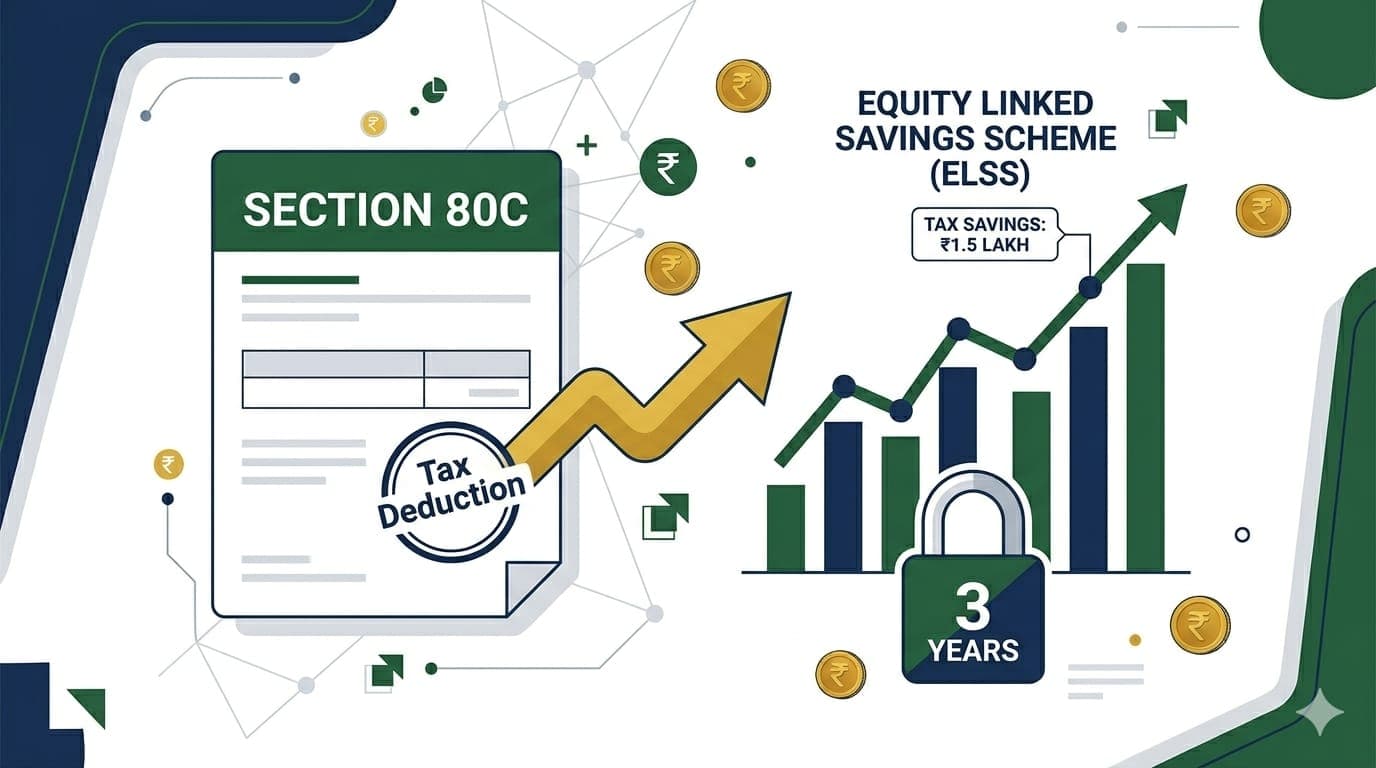
Most salaried investors exhaust Section 80C with EPF, insurance, and home loan principal — yet they miss that ELSS investments can claim a deduction of up to ₹1.5 lakh under Section 80C, while also building long-term wealth through equity. ELSS has the shortest lock-in period among popular 80C options: just 3 years.
Key takeaways
At a glance
Question | Short answer |
|---|---|
What is ELSS tax saving? | Equity mutual funds that qualify for up to ₹1.5 lakh deduction under Section 80C, with a 3-year lock-in — the shortest among popular tax-saving options. |
Is ELSS better than PPF or tax-saving FDs? | ELSS carries market risk but offers growth potential. PPF and FDs offer stability with longer lock-ins. The right choice depends on your risk profile and goals. |
Can I invest via SIP? | Yes. Each SIP instalment has its own 3-year lock-in from the date of that specific investment. |
Does ELSS still make sense under the new tax regime? | Under the new regime, no 80C deduction applies — but ELSS remains a valid equity investment product to be evaluated like any diversified equity fund. |
Is this investment advice? | No. Financial education only. For personalised advice, consult a SEBI-registered investment advisor (RIA). |
Section 1
What is ELSS tax saving and why serious investors care about it
Equity Linked Savings Schemes (ELSS) are equity-oriented mutual funds that qualify for tax deduction under Section 80C of the Income Tax Act — up to ₹1.5 lakh per financial year. They combine two powerful ideas: tax saving today and potential wealth creation in the long term through equity markets.
Unlike traditional 80C options such as PPF or tax-saving FDs, ELSS invests primarily in stocks. This means higher short-term volatility — but also the possibility of better inflation-beating growth over long horizons. For investors who want both financial education and tangible tax benefits, ELSS is usually the first equity product they seriously explore.
Section 2
ELSS vs other 80C tax saving options: lock-in, liquidity and risk
80C option | Asset type | Lock-in | Risk level |
|---|---|---|---|
ELSS | Equity mutual fund | 3 years (per instalment) | High — market linked |
PPF | Govt-backed fixed income | 15 years | Low |
Tax-saving FD | Bank fixed deposit | 5 years | Low to moderate |
NPS | Mixed (equity + debt) | Till retirement | Moderate, variable |
The right comparison is not "safe vs unsafe" — it is "fixed income with low volatility" versus "equity with higher risk and higher growth potential." This is where mutual fund risk analysis and clear goal setting become essential before you allocate.
Section 3
How ELSS works under old vs new tax regime
Old tax regime
ELSS qualifies for deduction of up to ₹1.5 lakh under Section 80C. Functions as both a tax-saving and wealth creation tool — the dual benefit most investors are familiar with.
New tax regime
No Section 80C deduction applies. ELSS becomes a pure equity mutual fund investment — evaluate it like any diversified equity fund using risk-adjusted returns, alpha, beta, and rolling returns.
The new regime does not make ELSS irrelevant — it simply changes the primary reason for investing. If equity exposure fits your goal and risk profile, ELSS remains a valid choice regardless of tax regime.
Section 4
Building ELSS wealth with SIP investment strategies
Many investors make a lump sum ELSS investment in the last week of March, just before tax deadlines. This is stressful and exposes your entire investment to a single market entry point. A more disciplined approach is systematic SIP investment throughout the year.
How ELSS SIP lock-in works
Each SIP instalment has its own 3-year lock-in from the date of that specific investment. A SIP on 5 April 2025 unlocks on or after 6 April 2028. A May instalment unlocks in May 2028. You cannot redeem all units at once after 3 years — you can only redeem instalments as they individually unlock.
Fix a monthly SIP amount that helps you approach ₹1.5 lakh over the year if maximising 80C deduction is a priority
Avoid stopping SIPs when markets fall — that is often when valuations improve and future returns are built
Review your ELSS fund choice annually using portfolio analysis — not monthly in reaction to short-term moves
Section 5
Evaluating ELSS performance: rolling returns, Sortino ratio and consistency
ELSS evaluation should go well beyond the 1-year returns that most ads highlight. On rolling 5-year windows, ELSS funds delivered an average rolling return of 16.1% vs 15.8% for the Nifty 500 TRI — and about 12 of 26 ELSS funds beat the benchmark on every rolling window studied. This type of analysis reveals consistency across different market phases, not just lucky timing.
Metric | What it reveals for ELSS analysis |
|---|---|
Rolling returns | Consistency across market phases — far more reliable than point-to-point CAGR for evaluating ELSS over its 3+ year intended holding period |
Sortino ratio | Focuses on downside volatility specifically — shows how the fund protects capital during market stress |
Alpha | Whether the fund manager is adding value over the benchmark after adjusting for risk |
Beta | Sensitivity to market moves — helps set expectations for how your ELSS NAV will behave in corrections |
Active weight | How differentiated the portfolio is from the benchmark — low active weight with high fees signals poor value |
Did you know
85% of ELSS funds beat the Nifty 500 TRI on a point-to-point basis over the last five years (as of Aug 21, 2025) — highlighting how tax-saving equity funds can also compete strongly with broad market benchmarks.
Section 6
Mutual fund selection guide for ELSS: process, not tips
Most investors look for "best ELSS fund this year" — which usually means chasing last year's winner. Instead, treat ELSS selection as part of your overall equity asset allocation, then choose the specific fund using a structured process.
1
Screen ELSS funds with at least 7 to 10 years of history where available
2
Check rolling 3-year and 5-year returns vs benchmark — not just point-to-point figures
3
Use Sortino ratio and downside capture to see how the fund behaves during corrections
4
Verify that the portfolio style — large cap vs mid cap mix, sector weights — matches your risk comfort
5
Compare expense ratios between direct and regular plans — understand the long-term cost difference before choosing
Section 7
Direct vs regular ELSS mutual funds: costs, control and compliance
Feature | Direct ELSS plan | Regular ELSS plan |
|---|---|---|
Expense ratio | Lower — no embedded commission | Higher — includes distributor commission |
Who executes | Investor via platform or AMC directly | Distributor or agent handles transaction |
Advice quality | Depends on SEBI-registered RIA you hire separately | May involve sales incentives — not governed by SEBI RIA rules |
Control and transparency | Higher | Moderate |
Going direct shifts the responsibility of research and monitoring to you — which is why financial education becomes essential. The goal is to help you decide which route suits your situation, then work with a SEBI-registered RIA for personalised advice when needed.
Section 8
Risk management in ELSS: mutual fund risk analysis you can actually use
ELSS is often sold purely on the tax angle — but serious investors focus on risk management first. Analysis should cover volatility, drawdowns, concentration risk, sector exposure, and behaviour in past market crises. Historical data cannot predict the future, but it shows how the fund has handled stress periods.
A core part of financial education is behavioural risk: many investors panic and redeem ELSS as soon as the 3-year lock-in ends, regardless of whether their goals are still years away. Match ELSS holding periods with your real life goals — so tax benefits and compounding can work together instead of pulling in opposite directions.
Did you know
AMFI data shows 42 ELSS funds with ₹2.39 trillion (₹2.39 lakh crore) in assets under management as of June 2024 — highlighting how central ELSS has become in India's tax-saving and equity investing landscape.
Section 9
Inside the live mutual fund workshop: learn ELSS the way pros analyse it
The live, interactive mutual fund workshop uses real ELSS funds as case studies to teach rolling return analysis, Sortino ratio interpretation, alpha and beta comparison, and active weight calculations vs benchmarks. The instructor has managed over ₹65,000 crore in AUM using Goldman Sachs strategies — bringing real portfolio responsibility, not just classroom knowledge.
Live Q&A segments — clarify doubts about ELSS, SIP lock-in mechanics, and risk management
Hands-on worksheets for ELSS fund selection that you can reuse for future annual reviews
Clear emphasis on SEBI guidelines — why the workshop does not give personalised advice, and how to work effectively with a SEBI-registered RIA
Money-back guarantee: If by the end of the session you feel you did not receive clear, practical value for your financial education, a refund can be requested within the specified window — subject to stated terms.
Section 10
Bonus materials, limited-time access and your next steps with ELSS
Post-workshop bonus materials typically include ELSS-focused evaluation checklists, a mutual fund selection guide template, and sample risk analysis sheets. These are time-bound to motivate immediate application rather than indefinite postponement.
Downloadable ELSS evaluation checklist — valid for a defined access period
SIP investment strategy examples tailored to different goal durations — purely for educational reference
Guidance on what questions to ask your SEBI-registered RIA to make the most of their expertise
Conclusion
ELSS: not just a March ritual — a structured path to tax efficiency and wealth
ELSS tax saving is not just a year-end scramble. It is a structured way to combine Section 80C efficiency with long-term equity exposure — provided you respect the 3-year lock-in, understand the inherent market risks, and evaluate funds using rolling returns, risk-adjusted metrics, and portfolio fit.
When viewed through the lens of professional analysis rather than marketing copy, ELSS becomes a powerful tool in your broader financial freedom plan. Financial education builds the skills to evaluate it properly. A SEBI-registered RIA ensures the plan is personalised to your situation. You need both.
enjoyed this article?
explore more insights on building wealth.