Best mutual funds in 2025: what smart investors do differently (and how you can too)
Stop searching for a "best mutual funds" list — start building your own. Learn how professionals evaluate funds using rolling returns, Sortino ratio, alpha & active weights, and how to create a personal shortlist of funds that genuinely fit your goals and risk profile.
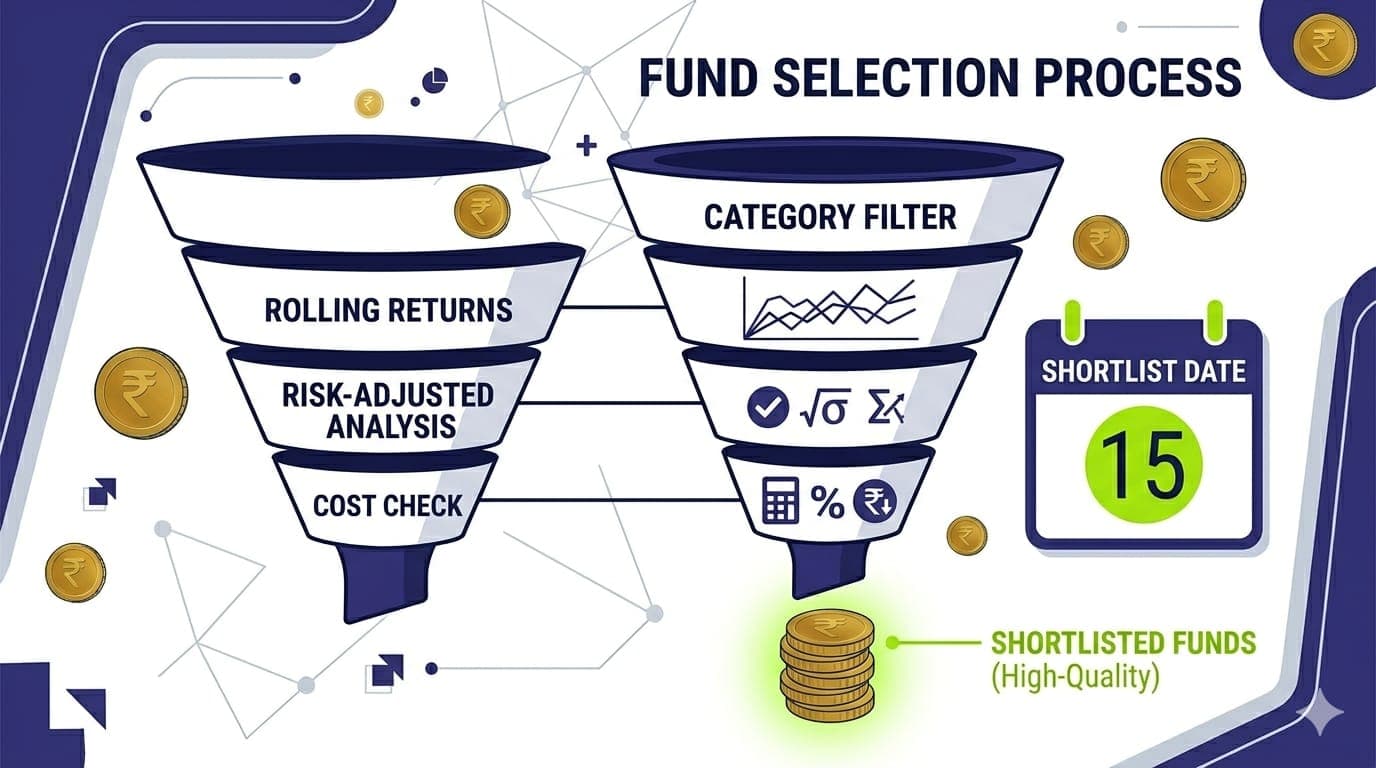
In 2024, US passive mutual funds and ETFs finally surpassed active funds in total assets — a clear signal that the definition of "best mutual funds" is changing fast. Choosing the right funds is no longer about chasing star ratings or past returns. It is about understanding risk, cost, and strategy so you can build a portfolio that actually serves your life goals.
The right question to ask
Which fund had the highest 1-year return?Which fund fits my goals, risk level, and time horizon — with consistent risk-adjusted performance?
What are the top 10 funds right now?What does my own fund selection checklist say about this fund across rolling periods?
Is this a 5-star rated fund?What is this fund's Sortino ratio, alpha, and active weight vs its benchmark?
Key takeaways
At a glance
Question | Answer |
|---|---|
What makes a mutual fund "best" for you? | The funds that fit your goals, risk tolerance, and time horizon — and score well on risk-adjusted returns, costs, and consistency. Not just recent performance. |
Are direct mutual funds always better? | Usually lower expense ratios — but only beneficial if you are willing to handle selection, rebalancing, and monitoring yourself. |
Can I learn professional techniques without a finance background? | Yes. Rolling returns, Sortino ratio, alpha, beta, and active weights are learnable with structured guidance — no quant background needed. |
Is this investment advice? | No. Educational content only. For personalised advice, consult a SEBI-registered investment advisor. |
Section 1
What "best mutual funds" really means for your financial freedom
When most people search for the best mutual funds, they expect a ready-made list of fund names. In reality, the best mutual funds for you are the ones that move you closer to your financial freedom goals with an acceptable level of risk and volatility.
Mutual fund investment is a skill — not a guess. Instead of chasing hot performers, the right approach is to evaluate funds logically, using data, risk analysis, and clear rules that match SEBI guidelines and your own financial plan.
Section 2
How professionals actually evaluate the best mutual funds
Inside Goldman Sachs and other large institutions, analysts never pick funds based on one-year returns or star ratings. They rely on a structured mutual fund selection process that looks at risk-adjusted returns, downside protection, and portfolio construction quality.
Rolling returns to test consistency through different market cycles — not just one convenient period
Standard deviation and beta to understand volatility and market sensitivity
Alpha to check whether the fund manager is genuinely adding value over the benchmark
Sortino ratio to focus on downside risk specifically, not just overall volatility
Active weight calculations to detect genuine active management versus closet indexing
Section 3
Risk-adjusted returns: the real test of "best" mutual funds
Two funds with the same return are not equal if one took twice the risk to get there. Risk-adjusted returns sit at the heart of professional fund analysis. Returns are meaningless without context.
Metric | What it tells you | Why it matters for fund selection |
|---|---|---|
Standard deviation | How much returns fluctuate around the average | Sets realistic expectations for NAV swings |
Beta | Sensitivity to market moves | Reveals how aggressively a fund moves with the index |
Alpha | Excess return for the risk taken | Tests whether active management is genuinely earning its fees |
Sortino ratio | Return per unit of downside volatility | Focuses on the risk that actually hurts investors |
Did you know
For U.S. active equity funds in 2024, about 42% survived and outperformed their asset-weighted passive peers — down from 47% in 2023. The bar for active funds to justify higher fees continues to rise.
Section 4
Rolling returns: how to avoid being misled by 3-year and 5-year charts
Most mutual fund factsheets highlight trailing 1-year, 3-year, and 5-year returns. These numbers can hide long periods of underperformance because they only show one snapshot. Rolling returns give you a far clearer view of how often a fund has actually beaten its benchmark across different market phases.
How to read rolling return data
Check what percentage of rolling periods the fund beat its benchmark — a high hit rate signals genuine consistency
Look at the depth and length of underperformance phases — how bad were the bad stretches?
Combine rolling returns with alpha and Sortino to get a complete risk-return picture before shortlisting
Section 5
Direct vs regular mutual funds: choosing the right route
Feature | Direct plan | Regular plan |
|---|---|---|
Expense ratio | Lower — no embedded distributor commission | Higher — includes distributor commission |
Who provides advice | DIY, or a fee-only SEBI-registered RIA you hire separately | Distributor support included — but not regulated as fee-only advice |
Best for | Investors willing to learn, select, and monitor independently | Investors who prefer guidance with less personal involvement |
With direct plans you take responsibility for mutual fund selection, rebalancing, and ongoing portfolio monitoring. The right choice depends on your comfort with financial education and your willingness to learn mutual funds in a deeper way.
Section 6
SIP investment strategies with the best mutual funds
SIP investment smooths out volatility and builds discipline — which is often more important than fund selection alone. The right SIP strategy combines equity, debt, and hybrid funds based on your time horizon and risk capacity.
1
Map each goal to a time horizon and appropriate risk level
2
Select appropriate fund categories first — not specific scheme names at this stage
3
Decide SIP amounts and start dates, then automate contributions
4
Review performance annually using rolling returns and risk metrics — not monthly
Did you know
Total net assets of the U.S. mutual fund market were $29.105 trillion in January 2025 — up 2.0% from December 2024. The global scale of mutual fund investing makes getting selection and risk analysis right more important than ever.
Section 7
Mutual fund portfolio analysis: how to review your existing funds
Many investors already hold 10 to 20 schemes and still feel uncertain about their progress. The solution is not adding more funds — it is doing a structured portfolio analysis to see overlaps, gaps, and hidden risks.
Check your equity, debt, and hybrid split versus your target allocation
Identify category duplication and an excessive number of funds doing the same job
Measure risk-adjusted returns for each core holding using Sortino ratio and rolling returns
Review expense ratios — especially for regular plans where cost drag compounds silently
Document an action list with clear, time-bound decisions for each fund
Section 8
Inside the live mutual fund workshop: Goldman Sachs strategies for everyday investors
The gap between how institutions evaluate the best mutual funds and how retail investors choose them is large. A live, interactive workshop closes that gap by bringing professional analysis down to a practical, step-by-step level — led by an instructor with Goldman Sachs experience managing over ₹65B AUM.
End-to-end mutual fund selection guide — from screening to final shortlisting
How to compute and interpret alpha, beta, and Sortino ratio in plain language
Using rolling returns and active weights to separate skilled managers from index huggers
How to design SIP investment strategies and review them annually without emotional interference
All sessions comply with SEBI guidelines and are for education — not stock tips. For personalised portfolios or specific scheme selection, always work with a SEBI-registered investment advisor.
Section 9
Money-back guarantee, limited seats, and bonus materials
The workshop comes with a clear money-back guarantee — attend the live sessions, do the exercises, and if you still feel you did not get value, a refund can be requested within the specified window with no complicated conditions.
Seats are intentionally limited to keep sessions interactive and ensure individual questions are answered. Bonus materials — ready-to-use fund selection checklists and portfolio review templates — are available for a limited time with new batches.
Section 10
Staying compliant and knowing when to seek professional advice
What we do
Teach professional-grade mutual fund analysis techniques
Show you how to run your own portfolio analysis
Help you ask better questions of your advisor
What we don't do
Give scheme-specific advice or guaranteed outcomes
Replace SEBI-registered RIAs or planners
Provide tax or estate planning guidance
Section 11
Building your personal shortlist of best mutual funds
There is no universal list of best mutual funds that works for everyone. What you can build is a personal shortlist grounded in data, aligned with your goals, and monitored with a clear process. The result is a compact set of funds you understand, trust, and can hold through market cycles with greater peace of mind.
1
Clarify your financial goals and time horizons before touching any fund data
2
Learn key metrics — rolling returns, alpha, beta, and Sortino ratio
3
Evaluate direct vs regular mutual funds for your specific situation and time availability
4
Design or refine your SIP investment plan with goal-linked allocations
5
Join a structured mutual fund workshop to accelerate learning and avoid common mistakes
Conclusion
The best mutual fund is the one you understand and can hold through cycles
The best mutual funds are not just the ones that performed well recently — they are the funds that fit your plan, protect you from unnecessary risk, and help you stay disciplined over years and decades. When you combine solid financial education with a clear mutual fund selection guide and regular portfolio analysis, you put yourself in a very small minority of investors who actually know what they own and why.
Whether you deepen your learning through a live workshop or continue exploring on your own, the skills you build today can support your path to financial freedom for the rest of your investing life.
enjoyed this article?
explore more insights on building wealth.