Asset allocation for Indian mutual fund investors: the one skill that matters more than stock picking
Asset allocation — not fund picking — is the #1 skill Indian mutual fund investors need. Learn how to split equity, debt & gold for your goals, risk profile, and SIP strategy. Includes Sortino ratio, alpha, beta, and rebalancing tips.
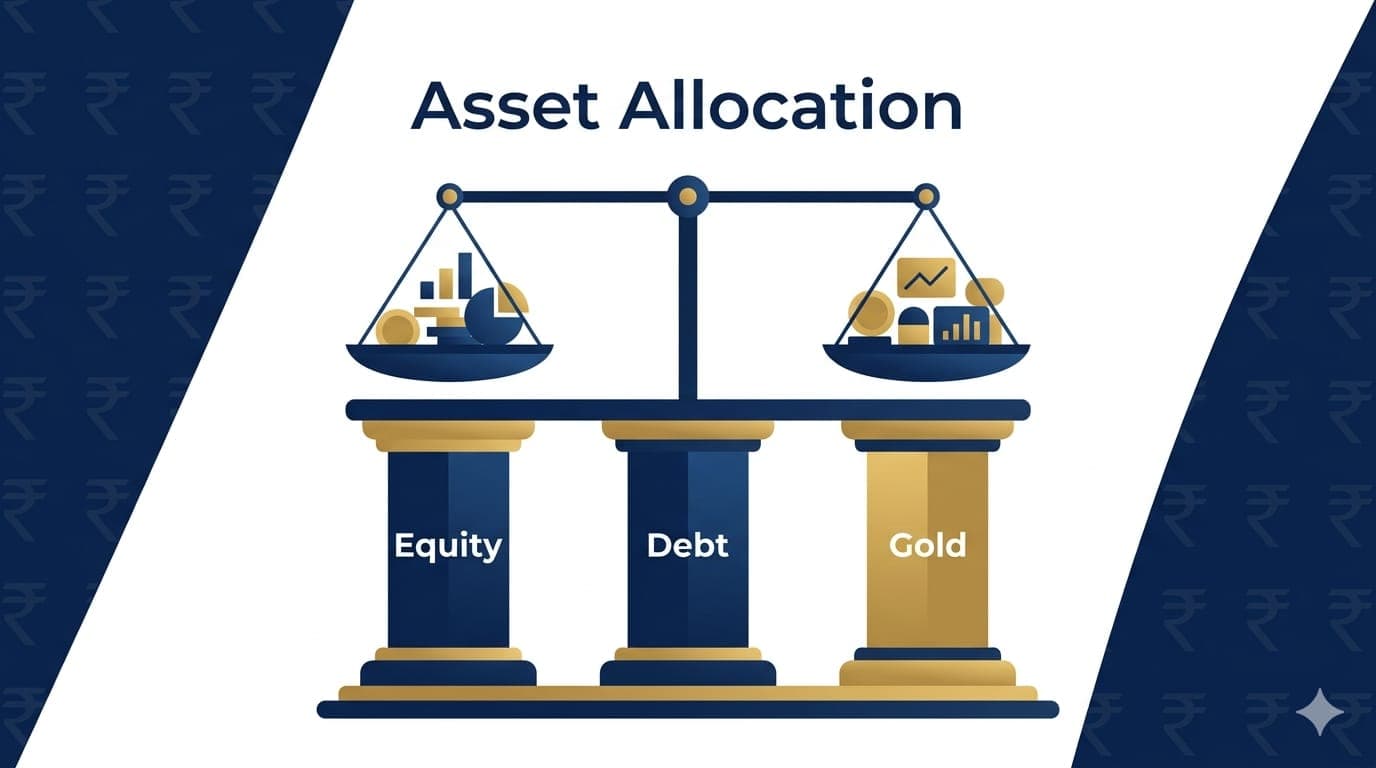
Nearly one-third of analyzed portfolios worldwide allocate between 55% and 65% to equities — showing just how central asset allocation is to real-world investing. If two investors using the same mutual fund products end up with very different results, the answer usually lies not in the funds themselves, but in how they split money across equity, debt, gold, and other assets.
Key takeaways
At a glance
Common question | Short answer |
|---|---|
What is asset allocation? | How you divide money across equity, debt, gold, and other assets. It matters more for long-term outcomes than the specific schemes you pick. |
How do I decide the equity vs debt split? | Base it on risk appetite, goals, and time horizon — then refine using mutual fund risk analysis rather than gut feeling. |
Is SIP investment enough on its own? | No. SIP is a good habit, but without a clear allocation framework your portfolio can become overexposed to risk or too conservative to meet your goals. |
Do I need a professional? | Always consult a SEBI-registered RIA for personalised advice. Financial education helps you ask better questions, not replace an advisor. |
What techniques improve risk-adjusted returns? | Rolling returns analysis, Sortino ratio, alpha/beta, and active weight calculations help you compare options and refine your selection. |
Direct vs regular — does allocation change? | The allocation logic is the same. What changes is cost. Lower expense ratios in direct plans can improve outcomes if the allocation is sensible. |
Section 1
Asset allocation basics: the foundation of every mutual fund portfolio
Asset allocation is simply how you spread money across different asset classes — equity, debt, gold, and sometimes real estate or alternatives. Instead of asking "which mutual fund is best?", the smarter starting question is "what mix of assets is right for me right now?"
Global studies and portfolio analysis work consistently show that allocation decisions explain most of the variation in long-term outcomes. Whether you invest through SIPs or lumpsum, your asset split usually matters more than the specific scheme name on your statement.
Section 2
Why allocation matters more than picking the "best" fund
Most investors spend 90% of their energy on fund selection and almost no time on deciding the right asset mix. That is backwards. A great equity fund in a wrong-allocation portfolio can still create a bad experience if the risk level is off for your situation.
Portfolios that look diversified on paper can be 80% equity plus small caps, with almost no stabilising debt. Asset allocation acts as a risk dial — it lets you control volatility, drawdowns, and the probability of staying invested through tough markets.
Section 3
Types of assets in Indian mutual fund investing
For most Indian investors, practical asset allocation starts with three main building blocks: equity mutual funds, debt mutual funds, and gold funds or ETFs. Each plays a different role in wealth creation.
Equity: Growth and wealth creation, higher volatility. Broken down into large cap, mid cap, small cap, flexi cap, and sectoral/thematic funds.
Debt: Stability and income, lower volatility, with interest rate and credit risk. Includes overnight, liquid, short duration, corporate bond, gilt, and target maturity strategies.
Gold: Hedge against currency weakness and crises, though it can be cyclical.
Section 4
Risk profiling and SEBI-compliant allocation frameworks
Before deciding on any equity-debt split, you need a clear view of your risk profile — your ability to take risk, your willingness to take risk, and your need to take risk.
Map your goals by time horizon: less than 3 years, 3 to 7 years, more than 7 years.
Assess your comfort with volatility using structured risk questionnaires.
Use that to arrive at broad buckets (conservative, moderate, or aggressive), then refine with numbers.
This content is for financial education only — it is not investment advice. For personalised allocation and scheme decisions, consult a SEBI-registered investment advisor (RIA).
Did you know
Cash holdings were 4.2% of assets under management globally, with investors net 14% underweight in bonds — signalling that many are taking more equity risk than they may realise.
Section 5
How SIP investment strategies work with asset allocation
SIP investment is a powerful way to build discipline, but SIPs alone do not guarantee good outcomes. If all your SIPs go into aggressive small-cap or thematic funds, you are still taking high risk even if the monthly amount is small. SIP is a mechanism; asset allocation is the plan.
Link each SIP to a goal and a target asset mix.
Review allocation at least once a year and after major market moves.
Use SIPs to gradually correct allocation imbalances instead of making sudden large shifts.
Section 6
Risk-adjusted returns: why Sortino ratio, alpha, and beta matter
Most investors only look at past returns when comparing mutual funds. That is exactly how portfolios end up overloaded with recent winners that may not fit the right risk level. Asset allocation must be built on risk-adjusted returns, not just raw CAGR numbers.
Metric | What it tells you | Why it matters for allocation |
|---|---|---|
Beta | Sensitivity to market movements | Helps control overall portfolio volatility by mixing high and low beta funds. |
Alpha | Excess return over benchmark after adjusting for risk | Useful for deciding how much to allocate to active vs passive strategies. |
Sortino ratio | Return per unit of downside risk | More relevant than Sharpe for equity allocation — focuses on bad volatility specifically. |
Section 7
Active vs passive, and direct vs regular mutual funds
Global data shows that active funds still account for about 41% of portfolio allocations, meaning professional investors still see value in thoughtful active bets — especially in less efficient segments.
Use passive funds for core market exposure where markets are highly efficient.
Consider active funds for segments where skilled managers can add alpha.
Compare total costs and advisory models before choosing direct vs regular plans.
Did you know
Alternative allocations averaged 10% of portfolios in H1 2025, up from roughly 4.3% earlier — investors globally are diversifying beyond just equity and bonds.
Section 8
Real-world portfolio analysis: rolling returns and active weights
Instead of only looking at 1-year or 3-year point-to-point returns, rolling returns show how a fund or asset class behaved across different market cycles — giving a more realistic picture of drawdowns and recovery times.
Active weight calculations show how far your portfolio deviates from a sensible reference allocation. If your target is 60% equity but you are actually at 80%, your active equity weight is +20%. That is not always bad — but it should be intentional, not accidental.
Important: None of this is a buy or sell recommendation. It is educational content to help you understand what is happening inside your portfolio so you can make better-informed decisions with your SEBI-registered advisor.
Section 9
Dynamic asset allocation: when and how to rebalance
Asset allocation is not a one-time decision. Markets move, your SIPs keep adding units, and over time the mix naturally drifts from your target. Rebalancing brings it back in a disciplined way — without emotional timing decisions.
Use new SIP flows to tilt gradually toward underweight assets.
Avoid very frequent rebalancing — it increases costs and tax impact.
Coordinate major life events (job changes, property purchases) with allocation reviews.
Consider rebalancing when any asset class drifts more than 5 percentage points from its target.
Conclusion
The core skill every investor needs
Asset allocation is not a fancy topic reserved for institutions. It is the core skill every mutual fund investor in India needs — whether you invest ₹5,000 per month via SIP or manage a multi-crore portfolio. The difference between a stressful investing experience and a calm, goal-focused one is usually not the latest "hot" fund, but a clear, disciplined allocation framework supported by basic portfolio analysis tools.
Focus on understanding equity, debt, and gold roles. Learn to read risk-adjusted metrics. Review your allocation at sensible intervals. Combine that with solid financial education and guidance from a competent SEBI-registered advisor, and you give yourself a much better chance of achieving long-term financial freedom on your own terms.
enjoyed this article?
explore more insights on building wealth.