Alpha and beta in mutual funds: what your advisor never clearly explained
Only 1 in 3 active funds beat their benchmark. Learn how alpha and beta help you measure fund manager skill, control portfolio volatility, and build smarter SIP strategies — explained in plain language, no finance degree needed.
Alpha and beta in mutual funds: what your advisor never clearly explained
Mutual fund education
Only 33% of active strategies survived and beat their passive peers in the 12 months ending June 2025 — meaning two out of three actively managed funds failed to deliver meaningful alpha after fees. Understanding alpha and beta is one of the simplest ways to stop guessing and take real control of your portfolio decisions.
Key takeaways
At a glance
Question | Short answer |
|---|---|
What are alpha and beta? | Alpha measures a fund manager's skill over a benchmark; beta measures sensitivity to market movements. Both are core inputs for serious portfolio analysis. |
How do they help in fund selection? | They let you compare funds on risk-adjusted returns instead of raw CAGR, so you can prefer funds that justify their risk and costs. |
Do they matter for SIP strategies? | Yes — SIP into a high-beta fund feels very different from SIP into a low-beta or negative-alpha fund. These metrics help you prepare mentally and financially for volatility. |
Can beginners understand this without advanced math? | Absolutely. The concepts can be explained in plain language with visual examples, no formulas required. |
Is this investment advice? | No. Everything here is financial education only. Always consult a SEBI-registered RIA for personalised recommendations. |
Section 1
Clear definitions that actually help you invest
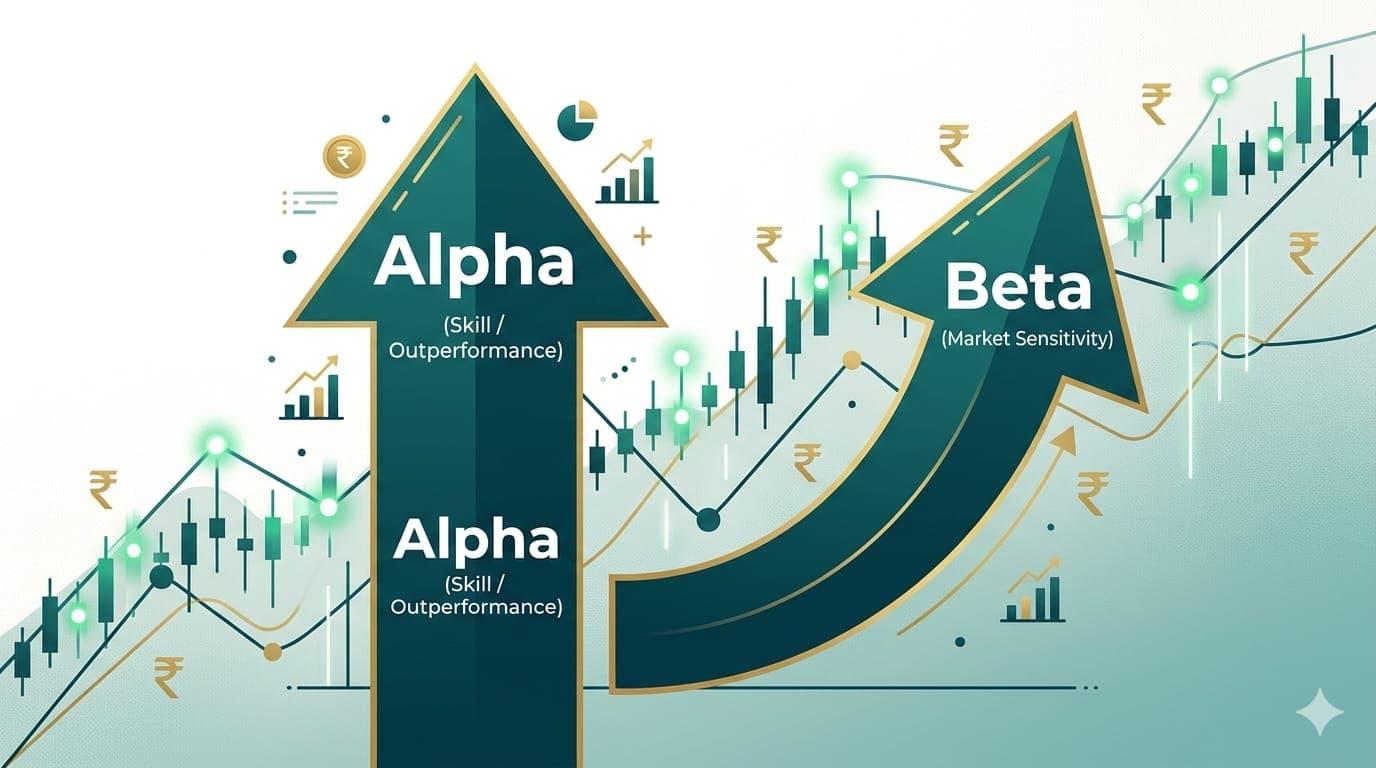
When we talk about alpha and beta in mutual funds, we are talking about two powerful metrics from modern portfolio theory. Alpha tells you how much a fund has outperformed or underperformed its benchmark after adjusting for risk. Beta tells you how aggressively the fund moves compared with the market.
Together, they turn vague opinions about a fund into measurable, comparable numbers. When you look at a large-cap equity fund, don't only ask "what is the 5-year return?" — also ask "what is the fund's alpha and beta versus the Nifty 50?" Once you combine alpha, beta, rolling returns, and the Sortino ratio, you get a much clearer picture of whether the fund is adding real value or just riding the market.
Section 2
Why alpha matters: measuring skill, not just return
Alpha is the "extra" return a mutual fund delivers compared with what you would reasonably expect given its beta and the market's performance. A positive alpha suggests the manager created value beyond simply taking market risk. A negative alpha suggests the fund did worse than a passive benchmark after accounting for risk.
When comparing active funds to low-cost index funds, alpha becomes the central question: are you getting enough extra value to justify higher fees and risk? What also matters is alpha consistency — a few great years can hide weak long-term skill, especially when you are building a portfolio for financial freedom through SIPs.
Section 3
Why beta matters: knowing how your fund reacts to markets
Beta answers a simpler but equally critical question: "How much does this fund typically move when the market moves 1%?"
Beta = 1: Moves in line with the benchmark index
Beta > 1: More volatile than the market
Beta < 1: Relatively defensive
Negative beta: Rare — moves opposite to the benchmark
For SIP investors, beta is often the difference between sleeping peacefully and panicking during corrections. A high-beta mid-cap fund can fall much faster than the index in a downturn, even if its long-term alpha is decent.
Did you know
65% of U.S. large-cap active funds lagged the S&P 500 in 2024 — reminding investors that high beta alone rarely compensates for weak alpha over time.
Section 4
Alpha and beta in mutual fund risk analysis
If you want to learn mutual funds properly, treat risk and return as a package. Alpha and beta sit at the center of mutual fund risk analysis because they tell you whether you are being paid appropriately for the volatility you experience.
Pair them with the Sortino ratio — which focuses on downside volatility rather than upside — and you can see if a fund's "good returns" came with painful drawdowns. Two flexi-cap funds might both show "very high risk" on SEBI's risk-o-meter, yet their beta and drawdown patterns can be very different.
Section 5
Using alpha and beta for smarter fund selection
Most investors choose funds based on star ratings, recent returns, or hearsay. A more professional selection process starts with identifying the right benchmark, then comparing alpha and beta across peers in the same category. This avoids comparing a high-beta small-cap fund to a low-beta large-cap index — like comparing a sports bike to a commuter scooter.
Step | What to check | Why it matters |
|---|---|---|
1 | Right benchmark and category | Alpha and beta are meaningless if the benchmark is wrong. |
2 | 3–7 year rolling returns | Shows consistency across different market cycles. |
3 | Alpha and beta vs peers | Helps separate skill from raw volatility. |
4 | Sortino ratio and drawdowns | Focuses on downside risk that actually hurts you. |
5 | Expense ratio and costs | High fees can destroy even decent alpha over time. |
This is an educational checklist — not investment advice. Use it to have more informed conversations with your SEBI-registered investment advisor.
Section 6
Direct vs regular mutual funds and the impact on alpha
Even the best active manager will struggle to show positive alpha if the cost drag is too high. Direct mutual funds have lower expense ratios because there is no distributor commission. Regular plans embed that commission in the fee structure.
From an alpha perspective, expenses are a direct negative. A fund might generate decent gross alpha at the portfolio level, but what you receive as an investor is net alpha after all costs. The takeaway: pay for advice transparently and ensure what you pay is justified.
Did you know
Among large-cap funds, the cheapest active options outperformed passives 28% of the time over 10 years — while the most expensive did so only 1.3% of the time. Costs quietly erode alpha.
Section 7
How Goldman Sachs experience shapes the workshop curriculum
The workshop curriculum is built by a mentor with Goldman Sachs experience and over ₹65B+ in assets under management in professional roles. The same analytical discipline used on institutional portfolios is what gets brought into your financial education — tools simplified, not rigor.
You learn active weight calculations, how institutional investors judge a manager's edge, and how risk desks look at factor exposures — all translated into simple checklists and Excel-friendly methods you can apply to your own portfolio without proprietary software.
Section 8
Live, interactive workshop: what you actually learn
The Master Mutual Funds Investment workshop is a 2.5-hour live, interactive session priced between ₹249 and ₹999 depending on the offer period. Not a pre-recorded video — you can ask questions in real time.
Topics covered: mutual fund mechanics, fund selection, performance analysis beyond basic returns, portfolio construction, hidden costs, and a dedicated Goldman Sachs style analysis module. Bonuses include a Starter Guide, Quick Hacks to Improve Portfolio Returns, a Monthly Portfolio Audit Checklist, and Portfolio Analysis Templates.
Money-back guarantee: If you attend live and feel the workshop did not add knowledge or clarity to your mutual fund decision-making, you can request a refund.
Section 9
Practical techniques: rolling returns, Sortino, alpha and beta
The workshop includes exercises where you calculate rolling returns, compare two funds with similar past CAGR but different volatility, then judge them on Sortino ratio and alpha. You will also work through active weight calculations — showing how managers overweight or underweight sectors relative to the benchmark and how that affects alpha and beta.
By the end, you will know how to read a fact sheet far beyond the marketing line items and identify whether a fund genuinely fits into your risk-adjusted returns framework.
Section 10
Building a SIP investment plan using alpha and beta insights
A good SIP plan is about more than picking popular funds and automating payments. When you integrate alpha and beta into your SIP strategies, you can consciously decide which funds will be your "growth engines" (higher beta) and which will act as stabilisers (lower beta, more predictable risk).
Map each SIP to a specific goal
Check if the fund's risk profile matches the goal's time horizon
Retirement SIPs can often handle higher interim volatility if alpha is reasonably consistent
Near-term goals need moderate beta and controlled drawdowns
None of this is a substitute for personal advice. Always discuss your plan with a SEBI-registered RIA before implementing large allocations.
Conclusion
Your framework for confident fund decisions
Alpha and beta are not just textbook concepts — they are practical tools that can change the way you look at every mutual fund you hold or plan to buy. Pair them with rolling returns, Sortino ratio, cost analysis, and clear goals, and you get a simple but powerful framework for mutual fund risk analysis and selection.
Use what you learn to ask better questions, evaluate funds more confidently, and build SIP strategies aligned with your financial freedom goals. For any personalised action plan, always speak to a SEBI-registered investment advisor who can tailor these concepts to your unique situation.
enjoyed this article?
explore more insights on building wealth.